
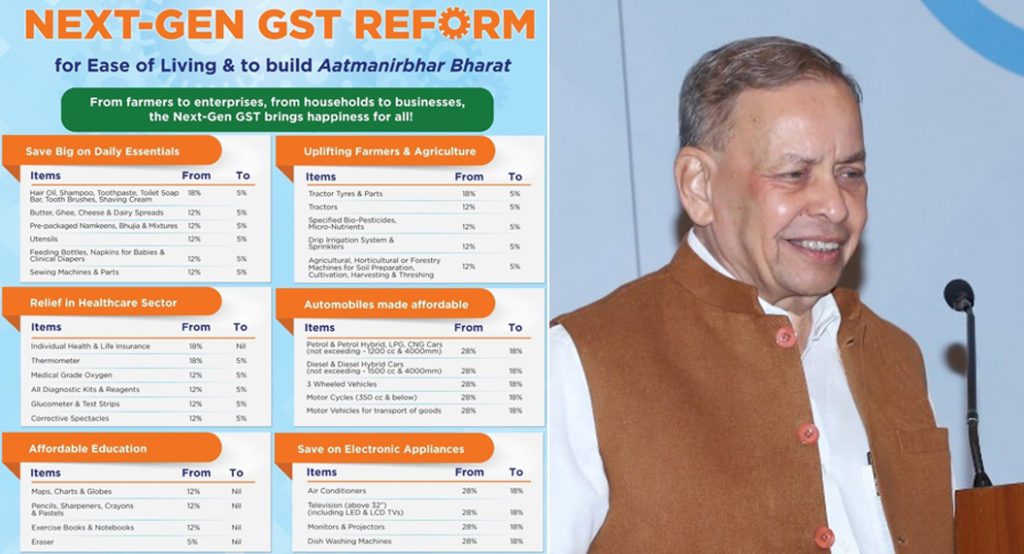
Satish Marathe, Co-Founder of Sahakar Bharati and a Director on the Board of the Reserve Bank of India, has lauded the government’s sweeping reforms in the Goods and Services Tax (GST) regime, calling them “momentous” and a game-changer for the economy.
Congratulating the government and the GST Council for the rate reductions, Marathe said the move would give a big push to consumption and manufacturing across all segments, particularly micro, small and medium enterprises (MSMEs). “On behalf of the CoOp Sector, I congratulate GOI & GST Council for slashing GST and giving a big push to consumption and manufacturing across all segments, particularly MSMEs,” he wrote.
Marathe emphasized that the decision would propel the economy to new heights by making products and services more affordable and competitive. He noted that reduced taxation would help expand the penetration of insurance services, thereby enhancing social security for citizens, especially in the lower- and middle-income groups. “It is a momentous reform and will propel economy to new heights,” he added.
Speaking later to Indian Cooperative, Marathe explained that all cooperatives in manufacturing, processing, and services would directly benefit from lower GST rates. “Overall, all items will be more affordable, giving a fillip to economic activities,” he observed, underlining the broad-based benefits for the cooperative movement.


One of the biggest takeaways is the exemption of ultra-high temperature (UHT) milk from GST, down from the earlier 5 percent levy. Similarly, condensed milk, butter, ghee, cheese, and paneer will now attract a reduced GST of 5 percent or nil, compared to the previous 12 percent. This is seen as a major boost for dairy cooperatives such as Amul and state federations, benefiting both farmers and consumers.
Agricultural cooperatives are set to gain from cuts on inputs like drip irrigation systems, bio-pesticides, and farm machinery, with rates reduced from 12 percent to 5 percent. Tractors and spare parts, crucial for rural productivity, also come under the revised rates, easing farmers’ financial burden.
Consumer cooperatives will benefit from lower GST on household essentials, including processed foods, soaps, toothpaste, and sewing machines. With rates down to 5 percent from 12 percent, cooperative retail outlets can pass on savings directly to members, improving affordability for ordinary households.
While banking and credit cooperatives are not directly impacted, they are expected to benefit from the economic momentum triggered by higher rural and semi-urban consumption. Cuts on renewable energy equipment such as solar heaters and biogas plants are also likely to aid rural cooperatives in expanding sustainable energy projects.
The Council further announced that the long-awaited Goods and Services Tax Appellate Tribunal (GSTAT) will be operational by the end of September 2025, providing cooperatives with a quicker dispute resolution mechanism.
Experts suggest that these reforms will lower operational costs, enhance competitiveness, and empower cooperatives to serve members more effectively. For a sector that remains a cornerstone of India’s rural economy, the GST cuts promise to accelerate inclusive growth and strengthen grassroots development.