
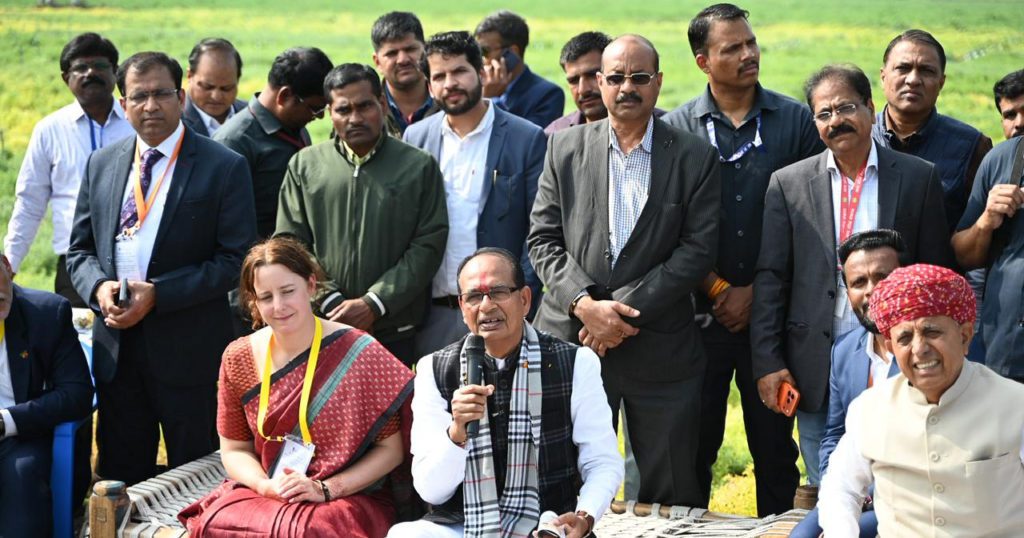
A new chapter in India’s pulses policy and farmer-centric agricultural discourse unfolded at the Food Legumes Research Centre in Amlaha, Sehore district of Madhya Pradesh, with the launch of a nationwide pulses revolution under the chairmanship of Union Agriculture and Farmers’ Welfare and Rural Development Minister Shivraj Singh Chouhan.
The National Pulses Consultation and Strategy Meeting brought together agriculture ministers from several states, senior scientists, representatives of ICAR and ICARDA, farmer producer organisations, progressive farmers, and stakeholders from the seed and pulses milling sector, signalling a clear shift towards shaping agricultural policy from the ground rather than distant corridors of power.
From Amlaha, the roadmap for the Self-Reliance in Pulses Mission was finalised, marking a decisive push to end India’s dependence on imported pulses. Addressing the gathering, the Union Minister underlined that importing pulses should not be a matter of pride for the country and asserted that India must move decisively towards becoming a net exporter.
He dismissed apprehensions raised by the opposition over international trade agreements, stating categorically that not even the slightest impact would be allowed on the interests of Indian farmers and that all sensitive agricultural and dairy sectors remain fully safeguarded.
Chouhan said the opposition’s narrative that farmers would be ruined by global agreements stood exposed by facts. He credited Prime Minister Narendra Modi’s leadership for ensuring that farmers’ interests were protected while opening new avenues for growth, exports, and employment.
On behalf of farmers and agriculture ministers present, he conveyed gratitude to the Prime Minister, stating that Indian farmers today felt reassured that national interest and agricultural livelihoods had been kept at the centre of policy decisions.
Emphasising the spirit of cooperative federalism, the Union Minister lauded Madhya Pradesh for declaring the year as ‘Farmers’ Welfare Year’ and assured full support from the Centre. He said state-specific roadmaps would be prepared to advance the pulses mission according to local agro-climatic needs, ensuring productivity, profitability, and value addition at the regional level. Madhya Pradesh, he noted, continues to lead the country in pulses production, but the declining area under pulses cultivation must be reversed by making these crops more remunerative for farmers.
The meeting also focused on concrete interventions from seed to market. Chouhan announced that under the mission, 1,000 pulse mills would be set up across the country, with 55 proposed in Madhya Pradesh alone. The Centre will provide subsidies of up to‚ Rs 25 lakh per mill to promote cluster-based processing, enabling farmers to benefit directly from local value addition and employment generation. He reiterated the government’s commitment to ensuring fair prices for farmers when production rises.
A significant reform announced was the decentralisation of seed release and distribution. Seeds will no longer be released solely from Delhi but directly through states and farmer clusters. Farmers joining clusters will receive seed kits and financial assistance of‚ Rs 10,000 per hectare for model farming. Backed by intensive research at ICAR and ICARDA, efforts are underway to develop early-maturing, high-yielding, and disease-resistant varieties of major pulses such as chickpea, lentil, pigeon pea, urad, and moong.
The message from Amlaha was unambiguous: farmers’ interests remain secure, and self-reliance in pulses will be achieved through science-driven policy, assured markets, MSP support, and strong Centre-State collaboration. With the launch of the Self-Reliance in Pulses Mission, India has set its course towards transforming pulses from a vulnerability into a strength.