




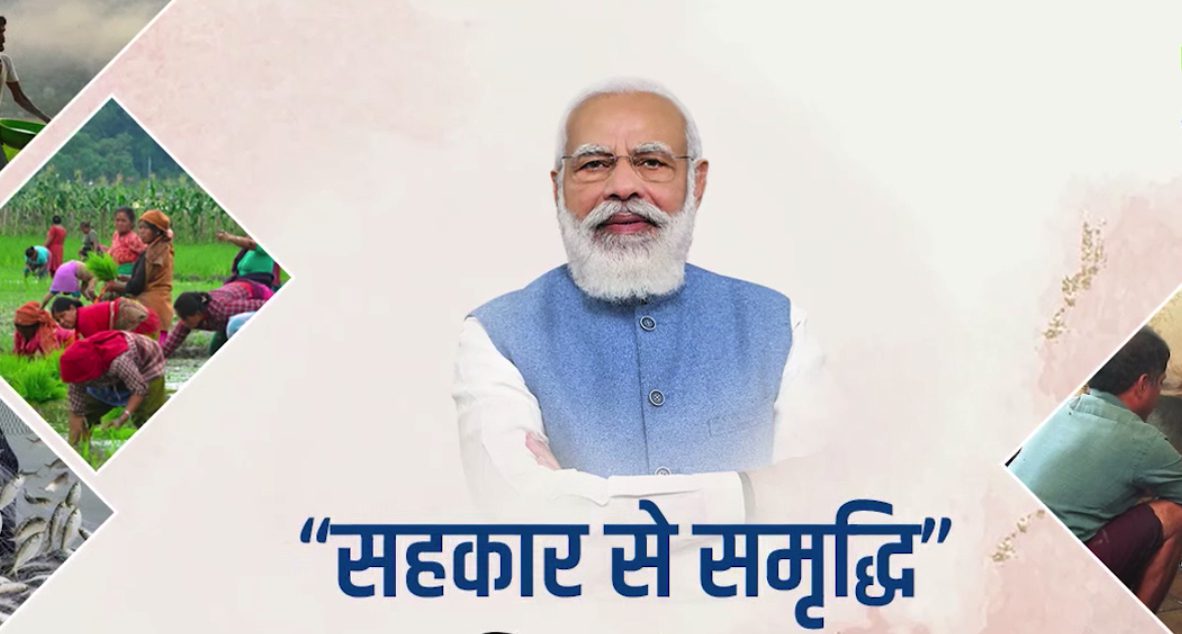
To realize the vision of “Sahkar se Samriddhi” envisioned by Hon’ble Prime Minister Shri Narendra Modi, a separate Ministry of Cooperation was established on July 6, 2021. Under the leadership and guidance of the first Cooperation Minister of the country, Shri Amit Shah, the Ministry has undertaken various initiatives and historical steps to make the cooperative sector strong and vibrant. In last 4 years, the Ministry of Cooperation has implemented 114 major initiatives, creating new opportunities for the economic development and expansion of cooperative societies across the country. The details and progress made so far on these initiatives are as under:
(A) Economic strengthening of Primary Co-operative Societies
- Model Bye-Laws for making PACS Multipurpose
Hon’ble Cooperation Minister Shri Amit Shah believes that PACS will be more empowered and economically viable when they are multi-purpose. Therefore, under his leadership the Model Bye-laws for PACS were prepared by Ministry of Cooperation after consultation with all States/UTs, National Federations and other stakeholders and were circulated on 05 January 2023. This will increase the sources of income of PACS/LAMPS and create new employment opportunities in more than 25 new sectors like dairy, fisheries, storage, etc. So far, 32 States/Union Territories have adopted the Model Bye-Laws or their existing Bye-Laws are in-line with the Model Bye-Laws.
- Strengthening of PACS through Computerization
Computerization of Primary Agricultural Credit Societies (PACS) is a Centrally Sponsored Scheme approved on 29 June 2022 to transform PACS into digitally enabled institutions by 31 March 2027. Initially approved for 63,000 PACS with an outlay of Rs 2,516 crore, also the project has been expanded to 79,630 PACS, with the total budget revised to Rs 2,925.39 crore.
The project is jointly funded by the Government of India, States/UTs, and NABARD:
Government of India: Rs 1,796.28 crore (earlier Rs 1,528 crore)
States/UTs: Rs 877.11 crore (earlier Rs 736 crore)
NABARD: Rs 252 crore
As of date, the Government of India has released Rs 1,067.50 crore, of which Rs 901.58 crore has been released to States/UTs for hardware procurement, digitization, and support systems, and Rs 165.92 crore to NABARD, the implementing agency is responsible for software development, cloud data storage, cybersecurity, training, and project management.
The Hon’ble Minister of Cooperation, Shri Amit Shah, has emphasized that the project will enhance transparency in PACS functioning and significantly strengthen public trust in the cooperative system.
In terms of progress as on date, 59,261 PACS are actively using the software, compared to 47,155 PACS as on 2 January 2025. Hardware has been delivered to 65,151 PACS, covering about 82% of the expanded target of 79,630 PACS (as against 57,578 PACS covered as of January 2025).
Certain new parameters are being tracked since 2025, such as online audits through the system, which have been completed in 42,730 PACS.
In the new e-PACS parameter, the Ministry achieved a significant milestone during Sewa Parv in October 2025 by enabling e-PACS in 17,168 PACS, far exceeding the target of 10,000. As on date, 32,119 PACS have attained e-PACS status.
The ERP software comprises of 22 functional modules, through which 34.94 crore transactions have been processed. The software is currently available in 14 languages, and 8 additional Constitutional languages are underway.
The project implementation commenced in FY 2022–23, with a sunset date of 31 March 2027.
- Establishment of Multipurpose PACS/Dairy/Fisheries Cooperative Societies in every Panchayat/Village
Under the leadership of Hon’ble Prime Minister Shri Narendra Modi, the Cabinet on 15th February, 2023 approved this Plan with the target of setting up new Multi-purpose PACS, Dairy, Fisheries Cooperative Societies covering all the Panchayats/villages in the country in the next 5 years. This Plan is being implemented with the support of NABARD, NDDB, NFDB and State Goverments, through convergence of various Government of India schemes at the level of these Primary Cooperative Societies. Committees at various levels, including an Inter-Ministerial Committee (IMC), National Level Coordination Committee (NLCC), State Level Cooperative Development Committees (SCDC) and District Level Cooperative Development Committees (DCDC) have been formed for implementation of this scheme. A Standard Operating Procedure (Margdarshika) has also been launched on 19.9.2024 to ensure timebound implementation of the Plan, wherein targets, timelines and roles and responsibilities of stakeholders concerned have been indicated. As per the National Cooperative Database, a total of 32,009 new M-PACS, Dairy and Fishery Cooperative Societies have been registered.
- World’s largest Decentralized Grain Storage Program in Cooperative sector to ensure food security
Under the leadership of Hon’ble Prime Minister Shri Narendra Modi, the Cabinet on 31st May, 2023 approved the World’s largest grain storage scheme in the Cooperative Sector, to be rolled out as a Pilot Project. It entails creation of various agricultural infrastructure such as godowns, custom hiring centres, processing units, fair price shops, etc. at PACS level through convergence of various Government of India schemes. Hon’ble Cooperation Minister Shri Amit Shah is giving special emphasis on this project as he believes that it will ensure food security of the country, reduce wastage of food grains, result in better price to farmers for their produce and meet various agricultural needs at the PACS level itself. Under the Pilot Project, godowns in 11 PACS of 11 States have been inaugurated and foundation stones for godowns construction in 500 additional PACS have been laid by Hon’ble Prime Minister on 24th February, 2024 at Bharat Mandapam, New Delhi.
Progress Status
Under Project, as on 30.12.2025 construction of godowns has been completed in 112 PACS across the country (Pilot Phase I – 11, Rajasthan – 82, Maharashtra – 15, Gujarat – 4) creating a total storage capacity of 68,702 MT
In order to broaden implementation capacity and scale, the Plan was expanded beyond PACS to include all Cooperative Societies, Cooperative Federations, and Multi-State Cooperative Societies (MSCS).
- PACS as Common Service Centres (CSCs) for better access to e-Services
An MoU has been signed on 2.2.2023 between Ministry of Cooperation, Ministry of Electronics and Information Technology, NABARD and CSC e-Governance Services India Limited for enabling PACS to deliver more than 300 e-services provided by CSC. The onboarded PACS are also being provided training by NCCT in coordination with CSC-SPV and NABARD. So far, 51,836 PACS have started providing CSC services and transactions worth more than Rs. 60 crores have been done through these PACS. Hon’ble Cooperation Minister Shri Amit Shah inaugurated this project on July 21, 2023 at Vigyan Bhawan, New Delhi. There is a plan to provide CSC facilities through all the functional PACS/LAMPS of the country which are being computerized.
- Formation of new Farmer Producer Organizations (FPOs) by PACS
Under the FPO scheme, 1100 additional FPOs have been allotted to the National Cooperative Development Corporation (NCDC) in cooperative sector. Now, PACS will be able to do other economic activities related to agriculture as FPOs. This initiative will also be helpful in providing the members of the cooperative societies with the necessary market linkage to get fair and remunerative prices for their produce. Hon’ble Cooperation Minister Shri Amit Shah inaugurated this project on July 14, 2023 at IECC, Pragati Maidan, New Delhi. Till now a total of 1863 FPOs have been formed in the cooperative sector by NCDC, out of which 1117 FPOs have been formed through strengthening of PACS. This will be helpful in providing farmers with necessary market linkages and get fair and remunerative prices for their produce. Under the scheme, an amount of Rs 206 crore has been disbursed to FPOs/CBBOs till date.
- Eligibility of PACS for LPG Distributorship
Under the leadership of Hon’ble Cooperation Minister Shri Amit Shah, the Ministry of Cooperation is working with a strong commitment to increase the business activities of PACS. Making PACS eligible for LPG distributorship is an important step towards this direction. Petroleum Ministry has amended its rules to make PACS eligible for LPG distributorship. Guidelines have been issued for obtaining LPG distributorship by PACS.
- Permission to convert Bulk Consumer Petrol Pump operated by PACS into retail outlets
On the initiative of the Ministry of Cooperation, the Ministry of Petroleum and Natural Gas has given consent to convert the existing bulk consumer licensee PACS into retail outlets. Under this initiative, PACS have been given a one-time option to convert their Bulk Consumer Petrol Pumps into retail outlets. 117 PACS from 5 States having Bulk Consumer Pumps have given consent for conversion into Retail Outlets, out of which 59 PACS have been commissioned.
- Priority to PACS for new Petrol/Diesel Pump dealerships.
PACS are also being given priority in new retail Petrol/ Diesel Pump dealerships. Guidelines have been issued by Oil Marketing Companies (OMCs)/ Petroleum Ministry for PACS to apply under Combined Category 2 (CC-2) as per locations advertised by OMCs. Till now 394 PACS/ LAMPS from 28 States/ UTs have applied online for retail petrol/ diesel dealership, out of which 10 PACS have been commissioned. This initiative will increase the profits of PACS and create new employment opportunities in rural areas.
- PACS as Jan Aushadhi Kendra for access to generic medicines at Rural level
In a meeting held on June 06, 2023 under the Chairmanship of the Hon’ble Cooperation Minister Shri Amit Shah with the Ministry of Chemicals and Fertilizers, PACS were enabled to operate Pradhan Mantri Bhartiya Jan Aushadhi Kendra (PMBJKS). With this initiative, cheaper generic medicines will be available to the common people at the village/ block level itself and PACS will get additional revenue streams. Interested PACS have been identified and encouraged by the State Government to apply online. So far, 4,192 PACS/ cooperative societies from 34 States/ UTs have applied online for PM Bhartiya Jan Aushadhi Kendra, out of which 4,177 PACS have been given initial approval by PMBI and 866 have received drug licences from State Drug Controllers and 812 PACS have got store codes from PMBI which are ready to function as PMBJK.
- PACS as Pradhan Mantri Kisan Samridhi Kendra (PMKSK)
On June 06, 2023, in a meeting held under the chairmanship of Hon’ble Cooperation Minister Shri Amit Shah with the Hon’ble Minister of Chemicals and Fertilizers, it was decided to upgrade the PACS that are already functioning as fertilizer distribution centres into Pradhan Mantri Kisan Samridhi Kendras (PMKSK). It was also decided to make PACS act as drone entrepreneurs for spraying fertilizers and pesticides. This will create new business opportunities for PACS and increase their profits. As per information provided by Department of Fertilizers (GOI) and States/ UTs, 38,190 PACS have been upgraded into PMKSK; the remaining are in progress.
- Micro-ATMs to Bank Mitra Cooperative Societies with the help of NABARD
Dairy and other cooperative societies have also been made Bank Mitra of District Central Cooperative Banks and State Cooperative Banks. To ensure their ease of doing business, transparency and financial inclusion, Micro-ATMs are also being given to these Bank Mitra Co-operative Societies with support from NABARD to provide ‘Door Step Financial Services’. For this a pilot project was launched on 21st May, 2023 and inaugurated on July 12, 2023 by Hon’ble Cooperation Minister Shri Amit Shah with the distribution of the cards to the account holders of the Panchmahal and Banaskantha District Central Cooperative Banks. Based on learnings of pilot, a state wide campaign named “Cooperation amongst Cooperatives” was launched on 15th January from Sanadar Dairy Complex, Banaskantha. A total of 12219 Bank Mitra have been appointed in Gujarat with issuance of 12624 micro ATM, covering all 14330 Gram Panchayats in state of Gujarat. The scheme added another revenue stream for Dairy cooperative societies and PACS besides generating employment for over 15,000. Based on learnings of the scheme, national wide rollout is planned as per the SOP of the ministry.
- Rupay Kisan Credit Card to Members of Cooperative Societies
A Pilot project has been started in Panchmahal and Banaskantha districts of Gujarat to expand the reach and capacity of Rural Co-operative Banks and to provide necessary liquidity to the members of Rural Co-operative Societies. Under this project, Bank Accounts of all the members of the cooperative societies are being opened in the concerned District Central Cooperative Banks and with the support of NABARD, Rupay-Kisan Credit Cards (KCCs) are being distributed to the account holders. Through Rupay-Kisan Credit Card, loans will be available to members of the Cooperative Societies at reasonable rate and members can also use this Card for other financial transactions. Based on learnings of pilot, a state wide campaign named “Cooperation amongst Cooperatives” was launched in state of Gujarat on 15th January from Sanadar Dairy Complex, Banaskantha. More than 22 lakh kisan credit cards have been issued through which more than 10,000 crores of loans have been disbursed creating entrepreneurship and employment. Based on learnings of the scheme, national wide rollout is planned as per the SOP of the ministry.
- PACS as Paani Samiti
In order to utilize the deep reach of PACS in rural areas, on the initiative of Ministry of Cooperation, Ministry of Jal Shakti has written a Letter to all the States/ UTs to make PACS eligible as ‘Paani Samiti’ to undertake the work of Operation and Maintenance (O&M) of Piped Water Supply schemes in rural areas. This step will strengthen the O&M work of water supply schemes in rural areas as well as create new business opportunities for PACS. So far, 962 PACS have been selected/ identified in 10 States/UTs, others are in process under this initiative.
- Convergence of PM-KUSUM Scheme at PACS Level
The reach of PACS, which have direct linkage with 13 crore farmer members, can be leveraged to set up decentralized solar power plants at the Panchayat level. With this, farmers connected to PACS would be able to ensure their energy security. Further, PACS and its member farmers will get alternative sources of income. The Ministry of Cooperation is in discussion with the Ministry of New and Renewable Energy on this subject.
- Formation of Fish Farmer Producer Organization (FFPO)
In order to provide market linkage and providing processing facilities to the fishermen, NCDC has registered 70 FFPOs in the initial phase. Department of Fisheries, Government of India has further allocated conversion of 1000 existing fisheries cooperative societies into FFPOs to NCDC, with an approved outlay of Rs225.50 crore. NCDC has so far facilitated the formation of 1,070 FFPOs, and the strengthening of 2,348 FFPOs is currently under progress. Under the scheme, an amount of Rs 98 crore has been disbursed to FFPOs/CBBOs.
(B) Three new Multi-State Cooperative Societies at the National Level
Under the guidance of Hon’ble Prime Minister Shri Narendra Modi and leadership of Hon’ble Cooperation Minister Shri Amit Shah, the Ministry of Cooperation constituted three new Multi-State Cooperative Societies for Exports, Certified Seeds and Organic Products
- New National Level Multi-State Cooperative Society for Exports
Government has established a new apex multi-state cooperative export society under the Multi State Cooperative Societies (MSCS) Act, 2002, namely National Cooperative Export Limited (NCEL) as an umbrella organization to focus on exporting the surpluses available in the Indian cooperative sector by accessing wider markets beyond the geographical contours of the country, thereby, increasing the demand of Indian Cooperative products/services across the globe and fetch best possible prices for such products/services. It will promote exports through various activities, including procurement, storage, processing, marketing, branding, labelling, packaging, certification, research and development, etc, and trading of all types of goods and services produced by cooperative societies. So far, 13,890 PACS/ cooperative societies have become members of NCEL. NCEL has so far exported approximately 13.77 LMT of Agri commodities like Rice, Wheat, Maize, Sugar, Onion, Cumin seed, etc., worth 5,556.24 Crore. During the financial year 2023-24, a dividend of 20% was provided by NCEL to its member cooperatives.
- New National Level Multi-State Cooperative Society for Certified Seeds
Government has established a new apex multi-state cooperative seed society under the MSCS Act, 2002, namely Bharatiya Beej Sahakari Samiti Limited (BBSSL) as an umbrella organization to focus on production, testing, certification, procurement, processing, storage, branding, labelling and packaging of all two generations of seeds i.e. foundation and certified, through PACS by leveraging various schemes and policies of different ministries of the Government of India. BBSSL has launched its seed under the brand ‘Bharat Beej’. So far, 31,605 PACS/ Cooperative Societies have become members of BBSSL.
- New National Level Multi-State Cooperative Society for Organic Farming
Government has established a new apex multi-state cooperative organic society under the MSCS Act, 2002, namely National Cooperative Organics Limited (NCOL) as an umbrella organization to provide institutional support for aggregation, certification, testing, procurement, storage, processing, branding, labelling, packaging, logistic facilities, marketing of organic products and facilitate in arranging financial assistance to the organic farmers through its member Cooperatives including PACS/FPOs along with promotional and developmental activities of organic products with the help of various schemes and agencies of the Government. So far, 10,035 PACS/ cooperative societies have become members of NCOL. NCOL has launched its products under the brand name of “Bharat Organics”. So far 28 organic products (Arhar Dal, Brown Chana, Chana Dal, Kabuli Chana, Masoor Malka, Masoor Split, Masoor Whole, Moong Dhuli, Moong Split, Moong Whole, Rajma Chitra, Urad Dal, Urad Gota, Urad Split, Urad Whole, Wheat Atta, Jaggery Cube, Jaggery Powder, Brown Sugar, Khandsari Sugar, Coriander Powder, Turmeric Powder, Fenugreek, Coriander Whole, Apple Cider Vinegar, Organic Goan Cashews, Organic Kashmiri Almonds, Organic Kashmiri Walnuts) under Bharat Organics brand are available in Delhi-NCR. Bharat Organics products are 100% batch tested for 245+ pesticides in accredited laboratories.
(C) Relief in Income Tax Law for Co-operative Societies
- Surcharge reduced from 12% to 7% for co-operative societies having income between Rs. 1 to 10 Cr.: This will reduce the burden of Income Tax on Cooperative Societies and more capital will be available with them to work for the benefit of their members.
- MAT reduced for cooperatives from 18.5% to 15%: With this provision, now there is parity between Cooperative Societies and Companies in this regard.
- Relief in cash transactions under section 269ST of the Income Tax Act: To remove difficulties in cash transactions by cooperatives under Section 269ST of IT Act, Government has issued a clarification that cash transaction of less than Rs. 2 lakhs done by a cooperative society with its distributor in a day will be considered separately, and will not be charged with income tax penalty.
- Tax cut for new manufacturing Cooperative societies: The Government has decided that a flat lower tax rate of 15% will be charged, compared to an earlier rate of up to 30% plus surcharge, for new cooperatives commencing manufacturing activities by March 31, 2024. This will encourage the formation of new cooperative societies in the manufacturing sector.
- Increase in limit of Cash Deposits and Payments by PACS and PCARDBs: The Government has enhanced the limit for Cash Deposits and Payments by PACS and Primary Cooperative Agriculture and Rural Development Banks (PCARDBs) from Rs. 20,000 to Rs. 2 lakh per member. This provision will facilitate their activities, increase their business and benefit members of their societies.
- Increase in the limit of Tax Deducted at Source (TDS) in Cash Withdrawal
Under the leadership of Hon’ble Prime Minister Shri Narendra Modi and the guidance of Hon’ble Cooperation Minister Shri Amit Shah Union Government through the Budget 2023-24, has increased the cash withdrawal limit of cooperative societies without deduction of tax at source from Rs.1 crore to Rs.3 crore per year. This provision will save Tax Deducted at Source (TDS) for cooperative societies, which they will be able to use to work for the benefit of their members.
- Enabling cooperatives to obtain low or nil TDS certificates
W.e.f. 01.10.2024, the S.194Q has been brought under the ambit of S. 197 enabling the taxpayers to apply for lower/nil deduction certificate in respect of transactions that require TDS compliance u/s. 194Q.
8. TCS on sale of goods under S.206C(1H) has been made ineffective
A sunset clause has been inserted in Section 206C(1H), rendering the provisions of the said section inapplicable with effect from 1st April 2025.
(D) Strengthening of Office of Central Registrar of Cooperative Societies
- Computerization of Central Registrar’s Office
The Office of the Central Registrar of Cooperative Societies is responsible for administering the Multi State Co-operative Societies (Amendment) Act, 2023. The office of the Central Registrar has been computerized to create a digital ecosystem for Multi-State Cooperative Societies. This will help in processing applications and service requests in a time bound manner through electronic work flow at the Central Registrar’s Office. It has provisions for OTP based user’s registration, verification check for compliance with MSCS Act and Rules, hearing through VC, issue of registration certificate and other communication, electronically. Hon’ble Cooperation Minister Shri Amit Shah inaugurated this Digital Portal on August 06, 2023.
- The Multi-State Co-operative Societies (Amendment) Act,2023
The Multi-State Co-operative Societies (Amendment) Act, 2023 aims to bring good governance in the MSCSs, increase transparency, accountability and improve election process. The MSCSs Bill was passed by the Lok Sabha on July 25, 2023 and by the Rajya Sabha on August 01, 2023.The Multi-State Co-operative Societies (Amendment) Act, 2023 has come into effect from 3rd August, 2023.
(E) Revival of Cooperative Sugar Mills
- Relief from Income Tax to Cooperative Sugar Mills
The Government has issued a clarification that cooperative sugar mills would not be subjected to additional income tax for paying higher sugarcane prices to farmers up to Fair and Remunerative or State Advised Price, from April 2016 onwards.
- Resolving decades old pending issues related to income tax of Cooperative Sugar Mills
The Government has made a provision in its Union Budget 2023-24, wherein Sugar cooperatives have been allowed to claim as expenditure their payments to sugarcane farmers for the period before the assessment year 2016–17, giving them a relief of more than Rs.46,000 crore.
- Rs 10,000 crore loan scheme through NCDC for strengthening of Cooperative Sugar Mills
Ministry of Cooperation has launched a new scheme named ‘Grant-in-aid to NCDC for Strengthening of Cooperative Sugar Mills’, under which Government of India is giving grant of Rs.1,000 crore to NCDC in two instalments of Rs. 500 crore each. The first instalment of Rs.500 crore was received during FY 2022-23 and second installment of Rs.500 crore is likely to be received during FY 2024. NCDC will use this grant to provide loans up to Rs. 10,000 crores to Cooperative Sugar Mills, which they will be able to use for setting up ethanol plants or for setting up cogeneration plants or for working capital or for all three purposes. Rs. 10,005 Crore has been sanctioned by NCDC for 56 Cooperative Sugar Mills.
- Preference in purchase of ethanol to Cooperative Sugar Mills and establishment of Cogen Power Plants
Cooperative Sugar Mills have now been put at par with private companies for ethanol procurement by the Government of India under the Ethanol Blending Programme (EBP).
- Reduction in GST on Molasses from 28% to 5% to help Cooperative Sugar Mills
The Government has decided to reduce the GST on molasses from 28% to 5% which will enable cooperative sugar mills to earn more profits for their members by selling molasses to distilleries with higher margins.
(F) Redressal of difficulties faced by Co-operative Banks
Under the leadership of Hon’ble Prime Minister Shri Narendra Modi and untiring efforts of the Hon’ble Cooperation Minister Shri Amit Shah, many important decisions have been taken to resolve the difficulties being faced by the Cooperative Banks in their business.
- Urban Cooperative Banks (UCBs) have been allowed to open new branches to expand their business: UCBs can now open new branches up to 10% (maximum 5 branches) of the existing number of branches in the previous financial year without prior approval of RBI.
- UCBs have been allowed by RBI to offer doorstep services to their customers: Door step banking facility can now be provided by UCBs. Account holders of these banks can now avail various banking facilities at home such as cash withdrawal, cash deposit, KYC, demand draft and life certificate for pensioners, etc.
- Notification of Scheduling norms for including Urban Cooperative Banks: UCBs that meet the ‘Financially Sound and Well Managed’ (FSWM) criteria and have maintained the minimum deposits required for classification as Tier 3 for the last two years are now eligible to be included in Schedule II of the Reserve Bank of India Act, 1934 and get ‘Scheduled’ status.
- A Nodal Officer designated in RBI for regular interaction with UCBs: In order to meet the long pending demand of the cooperative sector for closer coordination and focused interaction, RBI has notified a nodal officer.
- Relief for Urban Cooperative Societies (UCBs) by reducing PSL target from 75% to 60%: RBI had increased the priority sector lending (PSL) target for UCBs to 75%, due to which UCBs were facing a lot of constraints. Now the target for UCBs has been reduced from 75% to 60%, which gives a lot of relief to these banks.
- Housing loan limit for Urban Cooperative Banks increased from 10% to 25%: Housing loan limit for members of Urban Cooperative Banks has been increased from 10% of assets to 25% (up to Rs 3 crore) of their total loan & advances.
- Relief in sub-limit of 12% sub-limit (weaker sections) by withdrawing of target of Rs 2 lakh for women loan repayment: Removal of the target of Rs 2 lakh for women borrowers under the 12% sub-limit for weaker sections simplifies PSL compliance and provides UCBs greater operational freedom in meeting PSL obligations.
- Relief to Urban Cooperative Institutions by increasing 50% loan limit from Rs 1 crore to Rs 3 crore: The loan and advances exposure limit for Urban Cooperative Banks (UCBs) at 50% of loans and advances has been increased from Rs 1 crore to Rs 3 crore, which helps them meet the higher credit demands of individual borrowers, supports business growth and improves their competitiveness in the retail and SME lending segments.
- Monetary ceiling doubled by RBI for Gold Loan: RBI has doubled monetary ceiling from Rs. 2 lakhs to Rs.4 lakhs, for those UCBs that meet the PSL targets.
- Umbrella Organization for Urban Cooperative Banks: RBI has accorded approval to the National Federation of Urban Co-operative Banks and Credit Societies Ltd. (NAFCUB) for the formation of an Umbrella Organization (UO) for the UCB sector, which aims to provide necessary IT infrastructure and operational support to around 1,500 UCBs.
- RBI extended the glide path for Security Receipts from FY 2025-26 to FY 2027-28: RBI, vide circular dated 24.02.2025, has provided an additional two years time for provisioning of non-performing assets through Asset Reconstruction Company for better management of capital and liquidity in urban co-operative banks so that these banks can minimize the losses on stressed assets.
- Cooperative banks have been allowed to make one-time settlement of outstanding loans, like Commercial Banks: Co-operative banks, through board-approved policies, can now provide the process for settlement with borrowers, along with technical write-off.
- Higher Housing Loan Limits: Reserve Bank of India has increased the individual housing loan limit for rural co-operative banks by two and a half times to Rs. 75 lakh and enabled them to lend to real estate up to 5% of total exposure.
- License fee reduced for Cooperative Banks for AePS: License fee for onboarding Cooperative Banks to ‘Aadhaar Enabled Payment System’ (AePS) has been reduced by linking it to the number of transactions. Cooperative financial institutions are now to get the facility free of cost for the first three months of the pre-production phase. With this, farmer members of onboarded Banks are now able to get the facility of banking at their home with through biometrics.
UIDAI on 01.08.2025 has introduced new framework for onboarding of Cooperative Banks on AePS. Now only StCBs are required to onboard as AUA/KUA, DCCBs will be allowed to use it through State Cooperative Bank as sub AUA/KUA.
- Non-scheduled UCBs, StCBs and DCCBs notified as Member Lending Institutions (MLIs) in CGTMSE Scheme to increase the share of cooperatives in lending: Cooperative banks are now able to take advantage of risk coverage up to 85 percent on the loans given. Also, cooperative sector enterprises are also be able to get collateral free loans from cooperative banks now. CGTMSE rationalized the eligibility criteria from 5% Gross NPA or less to 7% Gross NPA or less for registration of Cooperative Banks as Member Lending Institutions (MLIs) under Credit Guarantee Scheme (CGS).
- Banking Regulation Act is amended by the Government to make the term of Board of Directors of Cooperative Banks as per the constitution (maximum 10 consecutive years).
- Limit for Agricultural Cooperative Societies (Dairy) under Priority Sector Guidelines increased from Rs 5 crore to Rs 10 crore: RBI has increased the priority sector lending limit for Agricultural Cooperative Societies (Dairy) from Rs 5 crore to Rs 10 crore vide Master Direction dated 24.03.2025. This move enables banks to provide more credit support to Agricultural Cooperative Societies (Dairy), thereby strengthening agricultural infrastructure and boosting rural credit flow.
- Sahakar Sarathi (Shared Service Entity): To provide technological services to Rural Cooperative Banks (RCBs) and for their strengthening, RBI has given in-principal approval to NABARD for setting up of Sahakar Sarathi (Shared Service Entity).
- Rural Cooperative Banks Included in RBI’s Integrated Ombudsman Scheme: RBI vide its Notification dated 07.10.2025, has included rural cooperative banks with deposits of more than Rs 50 crore in its Integrated Ombudsman Scheme. This will bring more transparency and accountability in functions of rural cooperative banks.
- Permission for RCBs to Open New Branches through Automatic Route: RBI, vide master direction dated 04.12.2025, has permitted State Cooperative Banks (StCBs) and District Central Cooperative Banks (DCCBs) to open new branches (maximum 10) through automatic route.
- Relaxation in Financial Parameters for Providing Modern Banking Services by Cooperative Banks: RBI, vide master direction dated 28.11.2025, has relaxed the financial parameters for providing modern banking services by removing Gross and Net NPA and net profit conditions.
- Relief from Penalty Clause under FSWM Framework: RBI, vide master direction dated 04.12.2025 has replaced the FSWM framework with ECBA norms and removed the condition relating to absence of penalties in the previous two years, thereby enabling cooperative banks to expand their business operations.
(G) Expansion of National Cooperative Development Corporation (NCDC)
- New schemes for Cooperative Societies started by NCDC
“Grant in aid to National Cooperative Development Corporation (NCDC)” scheme under Ministry of Cooperation (MoC) has been implemented through NCDC, with an outlay of Rs.2000 crore for a period of four years from 2025-26 to 2028-29. Under the scheme, NCDC shall be provided grant in aid of Rs.2000 crore (Rs.500 crore each year from FY 2025-26 to FY 2028-29). Rs. 375 cr has been disbursed in this FY.
Several new schemes in various sectors such as ‘Swayamshakti Sahakar’ for self-help groups; ‘Dirghavadhi Krishak Sahakar’ for long term agricultural credit; ‘Dairy Sahakar’ for dairy and ‘Nandini Sahakar’ for women’s cooperative institutions etc. In the financial year 2024-25, NCDC disbursed the total amount of Rs. 95,183 Crores and has achieved 60% growth in disbursement of financial assistance. The target is to disburse about Rs 1,50,000 crore loan in next three years. Rs 95000 crore has been disbursed so far by NCDC in the financial year 2025-26. All States and State Cooperative Societies can avail loan schemes of NCDC. The Government of India has also permitted National Cooperative Development Corporation (NCDC) to issue bonds worth Rs 2000 crore with government guarantee, subject to the adherence of specified terms and conditions.
- SAHKAR TAXI
A Cooperative taxi service app like Ola/ Uber wherein bike/taxi drivers are direct members of the society has been registered. The service aims to provide higher remuneration to drivers with minimal commission cuts while having the best customer experience at an affordable cost. The cooperative is promoted by Amul, NAFED, NABARD, IFFCO, KRIBHCO, NDDB & NCEL with an authorized Share Capital – Rs 300 crore. Over 1,50,000 drivers and 2,00,000 customers have already registered on app in trial run in NCR and Gujarat. Over 5000 daily rides have been done in trial run before proposed official launch in January. The scheme is expected to have nation wide presence by 2029.
- Financial assistance by NCDC for Deep Sea Trawlers
NCDC has taken up the task of financing deep sea trawlers. Various financial assistances have been sanctioned by NCDC such as; Rs. 11.55 crores for purchase of 14 deep sea trawlers in Maharashtra at a block cost of Rs 20.30 crores, Rs 37.39 crores to Rajmata Vikas Macchimar Sahakari Sanstha Limted, Mumbai for setting up a seafood processing unit at a Block Cost of Rs.46.74 crores, Rs. 32.69 crores for Integrated Fisheries Development Project (IFDP) of Government of Kerala and NCDC has sanctioned the proposal of Shri Mahavir Macchimar Sahakari Mandali Limited, Gujarat for purchasing 30 deep sea trawlers with a block cost of Rs.36.00 crores.
(H) Inclusion of Cooperative Societies as ‘Buyer’ on GeM Portal
Under the leadership of Hon’ble Prime Minister Shri Narendra Modi, the Cabinet has approved Cooperative Societies to be registered as ‘Buyer’ on Government e-Marketplace (GeM) on 1st June, 2022. Hon’ble Cooperation Minister Shri Amit Shah e-launched the onboarding of Cooperative Societies on the GeM Portal on 09 August 2022 in New Delhi. Cooperative Societies will now be able to buy from around 67 lakh authentic sellers/service providers available across the country on the single platform of GeM. So far, 721 Cooperative Societies have been onboarded as buyers on the GeM portal. Further, Cooperative Societies are also being motivated to register as sellers on GeM. So far, 3,285 transactions have taken placeby these Cooperative Societies, amounting to Rs 396.77 crore.
(I) New National Cooperation Policy
- Formulation of New National Cooperation Policy
In order to realize Hon’ble Prime Minister Shri Narendra Modi’s vision of ‘Prosperity through Cooperation’, Hon’ble Cooperation Minister Shri Amit Shah has decided to formulate a new Cooperation Policy in the country. A Multidisciplinary and National level committee consisting of 48 members comprising experts and stakeholders from different States and across the Country has been constituted under the leadership of former Union Minister Shri Suresh Prabhu to formulate the New Cooperation policy. So far, 17 meetings of the Expert Committee have been held, during which detailed discussions were held with the stakeholders and the new National Cooperation Policy is expected to be ready soon.
(J) Creation of New National Cooperative Database (NCD)
- New National Cooperative Database for an authentic and updated data repository: A comprehensive database of cooperatives in the country has been developed with the support of State Governments to facilitate stakeholders in policy making and implementation of programmes/ schemes related to cooperatives across the country. So far, the database includes data on around 8.4 lakh cooperatives from 30 different sectors, involving approximately 32 crore members.
- Cooperative Ranking Framework: The Government launched the Cooperative Ranking Framework on 24th January 2025 to assess and rank cooperatives, State-wise and sector-wise. This ranking framework enables State RCS to assess Cooperative Societies’ performance based on key parameters, including audit compliance, operational activities, financial performance, infrastructure, and basic identity information. The States/ UTs can generate rankings of Cooperative Societies, initially of 12 major sectors, namely PACS, Dairy, Fishery, Urban Cooperative Banks, Housing, Credit and Thrift, and Khadi and Gram Udyog, Agro processing / Industrial, Handicraft, Handloom, Textile & Weavers, Multipurpose and Sugar at State, district and block levels, through the NCD portal. This ranking system aims to enhance transparency, reliability and competitiveness among cooperative societies, ultimately fostering their growth.
- Facility for States / UTs to integrate State RCS portal with NCD portal through API: The Ministry of Cooperation (MoC) developed a standard API for States to fetch the entire data of cooperative societies of the State from the NCD portal to their respective RCS portals, and shared the Standard API Specification Document and database schema with States on 27.05.2025. Subsequently, the Ministry shared document on Push APIs (End Point APIs) for live, event-driven data pushing from RCS portals to the NCD Portal, enabling real-time updates and new registration data, on 22.09.2025. The State of Rajasthan, Chhattisgarh and Bihar have completed integration with NCD portal. To further facilitate seamless integration of other State/UT RCS portals with NCD portal, an advisory along with comprehensive check list was issued to all States / UTs on 14.11.2025. As per the integration plan, it is essential for States/UTs to ensure development of reverse/pull API at their end and complete RCS computerization in accordance with the checklist for successful integration with NCD portal. This two-way integration will ensure synchronization of cooperative data across platforms.
(K) Education and Training in the Cooperative Sector
- Establishment of Cooperative University
Hon’ble Cooperation Minister Shri Amit Shah is of the view that planned development and empowerment of the Cooperative sector can happen only with trained manpower for which it is being planned to establish National Cooperative University for Cooperative education, training, consultancy, research and development. This University will ensure a sustainable, adequate and quality supply of trained manpower and work for capacity building of the existing personnel. This University will be first of its kind, a specialized University in the cooperative sector.
- Promotion of training and awareness through NCCT
- Under the Ministry of Cooperation, the National Council for Cooperative Training (NCCT) operates a nationwide network of 20 training institutes. This includes one National Institute, namely VAMNICOM, Pune; five Regional Institutes of Cooperative Management (RICMs) at Chandigarh, Bengaluru, Kalyani, Gandhinagar, and Patna; and fourteen Institutes of Cooperative Management (ICMs) located at Bhopal, Bhubaneswar, Chennai, Dehradun, Guwahati, Hyderabad, Imphal, Jaipur, Kannur, Lucknow, Madurai, Nagpur, Pune, and Thiruvananthapuram.
- During 2024–25, the National Council for Cooperative Training (NCCT) achieved its highest-ever training outreach, aligning closely with the Ministry of Cooperation’s reform, NCCT conducted 4389 training programs in the year 2024-25 which is 134% achievement on its training programmes and trained 315474 participants, which is 160 % more than the scheduled target of 196500 participants. This achievement was made possible through the special initiative programmes of the Ministry of Cooperation, namely Capacity Building for PACS on the CSC Portal and Pilot Projects for PACS, under which 944 training programmes were conducted and around 1,15,490 participants were trained during the year. The other Major Achievement of the year 2024-25 is given below:
- PACS remained the focal point of NCCT training, with 2248 programmes were conducted for PACS and trained 208849 participants.
- NCCT has developed a structured Capacity Building Training Module for New Multi-Purpose Cooperative Societies (MPCS) to strengthen governance, enhance operational efficiency, and promote business diversification. The module was launched by the Hon’ble Union Home and Minister of Cooperation, Shri Amit Shah, on 25 December 2024, and is designed to equip Board members and staff of New MPCS with essential managerial and operational competencies required for effective functioning and long-term sustainability.
- NCCT conducted CSC-oriented capacity-building training programmes for Primary Agricultural Credit Societies (PACS), surpassing the targets set for the year. A total of 30,210 PACS were covered against the target of 30,000, with 30,210 participants trained through 648 training batches conducted across 564 districts. The impact of these programmes has been significant, with participating PACS progressively transforming into digital service delivery centres at the grassroots level. Several PACS reported an additional income of 20–30 per cent through the provision of CSC-related services. The initiative also contributed to enhanced access to government, financial, and digital services in rural areas, thereby strengthening the role of PACS as key institutions for inclusive and technology-enabled service delivery.
- NCCT implemented a Pilot Capacity-Building Training Project for Primary Agricultural Credit Societies (PACS) across four districts—Una (Himachal Pradesh), Theni (Tamil Nadu), Sambalpur (Odisha), and Jodhpur (Rajasthan). Under this initiative, 295 training programmes were conducted, benefiting 85,219 participants. The project enhanced awareness among PACS members regarding Ministry of Cooperation schemes and Model Bye-laws, strengthened institutional capacities in DPR preparation, business diversification, and project planning, and demonstrated early signs of diversification—particularly in Himachal Pradesh—where PACS began exploring CSC services, Jan Aushadhi Kendras, drone services, and seed distribution activities.
- III. From April to November 2025, a total of 2889 programs have been conducted and 176094 participants have been trained by NCCT. Additionally, NCCT and its institutions are involving in the following initiatives during the year 2025:
- Implementation of the MPCS training module commenced from the Academic Year 2025–26. Under this, 8372 participants from 1753 new MPCS were trained covering 105 district from 17 states for business diversification and development of New MPCS.
- To commemorate the International Year of Cooperatives – 2025 and mark the completion of four years of the Ministry of Cooperation, the training units of the National Council for Cooperative Training (NCCT)—VAMNICOM, RICMs, and ICMs—organized Walkathon events across the country on 4 July 2025. A total of 16 Walkathon events were conducted, with 1,819 participants, aimed at creating public awareness on the significance of cooperatives, their role in nation-building, and the key initiatives of the Ministry of Cooperation.
- On 5 July 2025, to mark the International Year of Cooperatives – 2025 and the completion of four years of the Ministry of Cooperation, NCCT institutes (VAMNICOM, RICMs, and ICMs) conducted 66 One-Day Youth Awareness Programmes across the country, benefiting 9,819 university and college students and promoting awareness on the role of cooperatives in national development.
- Apart from that, NCCT institutes actively conducted National/ state level conference, Radio/TV talks and Debate/Quiz competitions on Cooperative policies and schemes.
- Under the guidance of the Ministry of Cooperation, and in consultation with the National Council of Educational Research and Training (NCERT), NCCT has designed and developed material on cooperation which aims at creating awareness among school students about the role of cooperatives in national development. The progress is as under,
- A chapter on Cooperatives for class 6 which has been included in the NCERT curriculum.
- Special Module on Cooperation for secondary stage students which has been introduced on NCERT website.
- Further, Draft material on National Education Policy (NEP) aligned, age appropriate, and grade specific special modules for class VI to X has been prepared and submitted for the comments and suggestion of NCERT.
- Chapter on Cooperatives for class XI and XII of NCERT students are also under preparation.
(K) Other Initiatives
- Computerization of Agriculture and Rural Development Banks (ARDBs)
To strengthen the Long-term Cooperative Credit structure, the Ministry of Cooperation has approved a Centrally Sponsored Scheme for computerization of 1,422 units of Agriculture and Rural Development Banks (ARDBs). It will have various components such as hardware procurement, comprehensive Enterprise Resource Planning (ERP) solutions, digitization, providing training and support, and maintenance of software, etc. 25 percent of the expenditure incurred in this scheme will be borne by the ARDBs and the remaining 75 percent by the Central and State Governments. Computerization will provide various benefits to ARDBs, such as increased efficiency, faster loan disbursement, reduced transaction costs, increased transparency and lower imbalances of payments, etc. So far, proposals received from 10 States/ UTs have been sanctioned. Further, GOI share amounting to Rs. 10.11 crores has been released to 10 states/UTs in FY 2023-24, FY 2024-25 and FY 2025-26 for procurement of hardware, digitization and setting up of support system. Hon’ble Home and Cooperation Minister Shri Amit Shah launched this Project on 30th January, 2024 at Pusa, New Delhi.
- Scheme for computerization of office of Registrar of Cooperative Societies in States/Union Territories
To increase ease of doing business for Cooperative Societies and create a digital ecosystem for transparent and paperless regulation in all States/Union Territories, the Ministry of Cooperation has approved a Centrally Sponsored Scheme for computerization of offices of Registrar of Cooperative Societies of all States/UTs. The software developed under this scheme will be based on the Cooperative Act of the respective States/UTs. Hon’ble Home and Cooperation Minister Shri Amit Shah launched the Project on ‘Computerization of Offices of Registrar of Cooperative Societies of all States and UTs on 30th January, 2024. So far, 35 States/UTs have submitted their proposal to the Ministry and Rs. 15.20 Crore (approx.) have been disbursed to 35 States/UTs in 1st instalment for procurement of hardware and Software.
- White Revolution 2.0
The Ministry of Cooperation has launched an initiative to usher Cooperative-led “White Revolution 2.0” aimed at expanding cooperative coverage, employment generation and women’s empowerment with an objective “To increase the milk procurement of dairy cooperatives by 50% from the present level over next five years by providing market access to dairy farmers in uncovered areas and increasing the share of dairy cooperatives in organised sector.” The SOP for White Revolution 2.0 was launched on 19.09.2024 by Hon’ble Home & Cooperation Minister in the presence of Hon’ble Minister of Fisheries, Animal Husbandry and Dairying. On 25.12.2024, the Hon’ble Home & Cooperation Minister, in the presence of the Hon’ble Minister of Fisheries, Animal Husbandry and Dairying, inaugurated 6,600 newly set up Dairy Cooperative Societies. So far, 20,070 DCSs have been registered in 31 states/UTs.
- Atmanirbharta Abhiyan
Ministry of Cooperation has launched the initiative to incentivize production of pulses (tur, masur and urad) to reduce dependency on imports, and production of maize to be used for production of ethanol for meeting the goal of Ethanol Blending Programme (EBP). National Cooperative Consumer Federation (NCCF) and National Agricultural Cooperative Marketing Federation of India (NAFED) are the central nodal agencies under this initiative, and have developed Esamyukti (NCCF) and Esamridhi (NAFED) portals respectively, for registration of farmers through cooperatives. For pre-registered farmers of tur, urad and masur pulses, the Government has guaranteed to procure 100% of the produce at Minimum Support Price (MSP). However, if market prices exceed the MSP, farmers are free to sell their produce in the open market for higher profits. Similarly, both the agencies guarantee 100% procurement of maize from pre-registered farmers throughout all three seasons – Kharif, Zaid, and Rabi, thus ensuring a steady supply of maize to ethanol distilleries and at the same time also encouraging farmers to cultivate maize. As of today, A total of 56,673 PACS/FPOs and 54,74,499 farmers have registered themselves on the above portals, and both agencies have purchased 9,08,332 metric tons of pulse (tur, masur & urad) and 45,105 metric tons of Maize.
- Refund to Investors of Sahara Group of Societies
Under the guidance of Hon’ble Prime Minister Shri Narendra Modi and leadership of Hon’ble Cooperation Minister Shri Amit Shah, Ministry of Cooperation filed a Petition in the Hon’ble Supreme Court and on the petition of the Ministry of Cooperation, the Hon’ble Supreme Court vide order dated 29.03.2023, directed to transfer Rs 5000 crore from Sahara-SEBI refund account to the Central Registrar of Co-operative Societies for disbursement of valid dues of the depositors of 4 Cooperative Societies of Sahara Group (Sahara Credit Cooperative Ltd., Saharayan Universal Multipurpose Society Ltd., Hamara India Credit Cooperative Society Ltd. and Stars Multipurpose Cooperative Society Ltd.).
Hon’ble Cooperation Minister Shri Amit Shah launched the ‘Central Registrar – Sahara Refund Portal’(https://mocrefund.crcs.gov.in) in New Delhi on 18th July, 2023. Stockholding Documents Management Services Ltd. (SDMSL) has been engaged to develop a transparent digital system (Portal) under the supervision and monitoring of former Justice for disbursement by the Central Registrar in compliance with the order of the Hon’ble Supreme Court. Officers on Special Duty (OSDs) have also been appointed by the Central Registrar for each of the above cooperative societies to supervise the refund process. The process of payment to the depositors has started from August 04, 2023. On an IA filed by the Ministry, Hon’ble Supreme Court vide Order dated 12.09.2025 directed that additional amount of Rs. 5000 crore from Sahara-SEBI refund account be transferred to the Central Registrar of Co-operative Societies for disbursement of valid dues of the depositors of 4 Cooperative Societies of Sahara Group. Till 22.12.2025, about 1.42 crore applications (Rs. 96,555 crore claims) have been received on the ‘CRCS-Sahara Refund Portal’. An amount of about Rs 7562.33 crore has been released to 37,48,190 depositors of Sahara Group cooperative societies.
Implementation Strategy
- Letters have been written by the Hon’ble Minister of Home and Cooperation to the Chief Ministers of all the states for the successful implementation of the Initiatives of the Ministry. From time to time, letters have also been written by the Secretary (Cooperation) to the Chief Secretary and other concerned officers for the implementation of the schemes.
- At National Level, regular review meetings under the Chairmanship of Secretary (Cooperation) are being held with concerned Departments, Agencies and the State Governments. So far 22 review meetings have been held with all the states.
- At State Level, State Cooperative Development Committees (SCDC) have been constituted under the chairmanship of the concerned Chief Secretary with Principal Secretary (Cooperation), Registrar Cooperative Societies (RCS), representatives of NABARD/NCDC etc. and Heads of concerned line departments. So far, 86 meetings of State Cooperative Development Committees have been held.
- At District Level, District Cooperative Development Committees (DCDC) have been constituted under the chairmanship of the concerned District Collector with District Registrar Cooperative Societies (DRCS) and Heads of concerned line departments. Till now, 2,735 meetings of District Cooperative Development Committees have been held.