





A new cooperative-led initiative in Bihar is creating fresh livelihood opportunities for informal workers, particularly domestic and care workers, by helping them organise into member-owned enterprises. The effort, led by the International Labour Organization (ILO) under its PRS Phase II project in collaboration with the Indian National Trade Union Congress, is being seen as a significant step towards formalisation and decent work in the state.
The initiative focuses on promoting cooperative models as a means to empower workers who traditionally operate in unregulated and low-income environments. By bringing them together into structured groups, the programme aims to enhance bargaining power, ensure fair wages and improve overall working conditions.
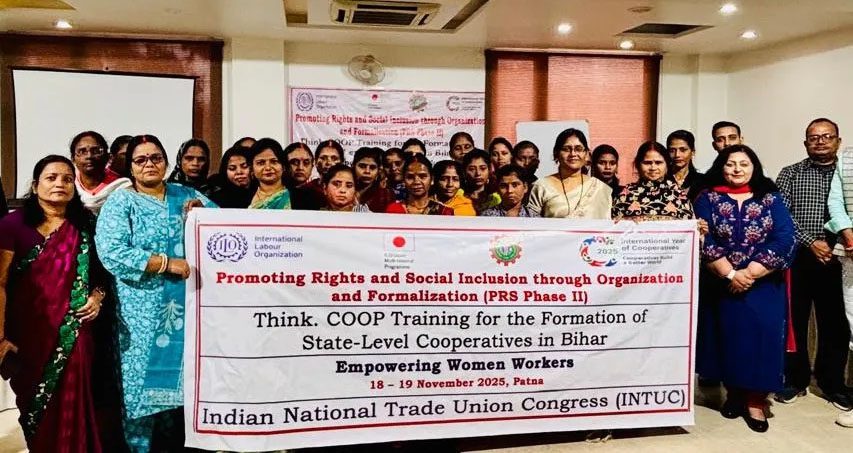
As part of this effort, the ILO conducted its specialised ‘Think.CareCoop’ and ‘Think.Coop’ training programmes, marking the first such initiative in Bihar. The ‘Think.CareCoop’ training was held in Patna in November 2025, while the ‘Think.Coop’ programme took place in Gaya in March 2026. Together, these sessions saw participation from over 80 women workers and community leaders, with active support from the state’s Cooperative and Labour Departments.
These training programmes are designed to build the capacity of participants to establish, manage and sustain cooperative enterprises. While ‘Think.Coop’ focuses on general cooperative development, ‘Think.CareCoop’ is tailored specifically for workers in the care economy, a sector that remains largely informal despite its growing importance.
According to Chandra Prakash Singh, the initiative is helping strengthen women’s agency and enabling informal workers to transition towards more secure and dignified livelihoods. He noted that the process of forming a state-level cooperative has already begun, which will allow workers to collectively negotiate better terms and reduce exploitation.
During the sessions, participants identified several potential cooperative ventures. These include organised care services for households and offices, which would ensure standardised wages and improved working conditions. Community-based childcare services also emerged as a key idea, aimed at reducing the unpaid care burden on women while generating employment.
In addition, participants explored small-scale, home-based enterprises such as tailoring, bangle-making and salon services. By adopting a cooperative approach, workers can bypass intermediaries, access better markets and retain a larger share of their earnings.
Experts believe that the cooperative model holds significant promise, especially in sectors like care services where demand is rising but labour conditions remain unregulated. By combining skill development with collective enterprise, the initiative addresses both income generation and social protection.
The Bihar initiative also highlights a broader shift towards recognising informal workers as key contributors to the economy and integrating them into formal systems through innovative approaches. With continued institutional support and scaling up, such models could be replicated in other states to create sustainable livelihood ecosystems.
-ILO