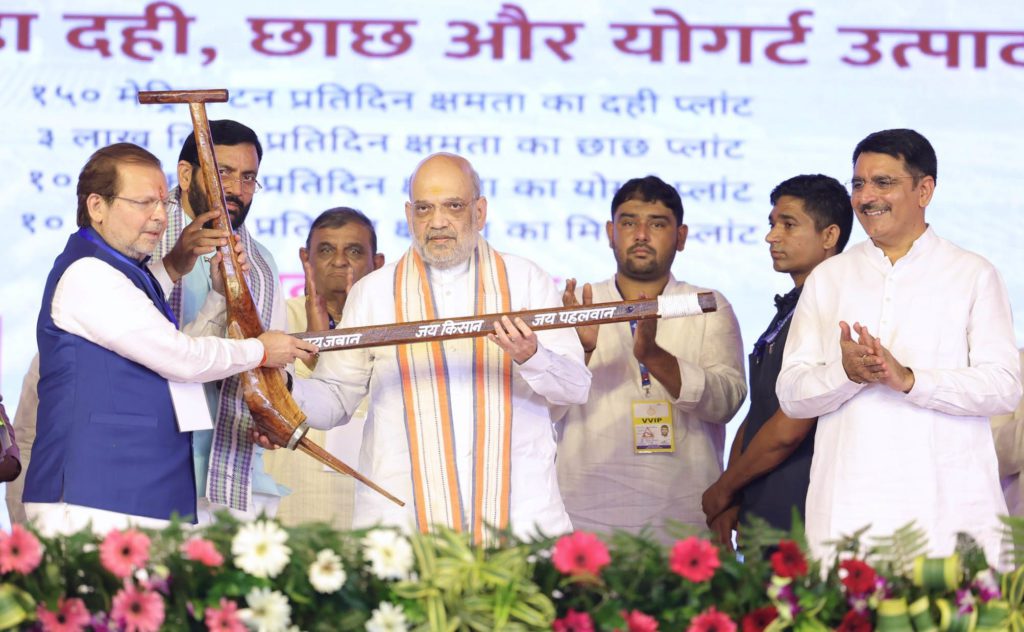
India’s largest cooperative dairy facility for curd and buttermilk commenced operations in Rohtak, Haryana, with the launch of the Rs 350-crore Sabar Dairy Plant. Designed to process 150 metric tonnes of curd, 10 metric tonnes of yogurt, 3 lakh litres of buttermilk and 10,000 kilograms of sweets daily, the plant is expected to cater to demand across Haryana as well as the wider Delhi–NCR belt.
Inaugurating the facility, Union Home and Cooperation Minister Amit Shah positioned the expansion as part of a nationwide cooperative revival strategy. He said the Centre aims to raise India’s total milk processing capacity from 66 million litres per day to 100 million litres per day by 2028–29, with new-generation cooperative plants leading the push. By 2029, he added, every panchayat in the country is expected to host a functioning cooperative society.
The Rohtak unit marks Sabar Dairy’s first major northern footprint after originating in Gujarat’s Sabarkantha district. Shah said the Gujarat model has already enabled over 35 lakh women to transact Rs 85,000 crore annually through dairy cooperatives, and emphasised that Haryana now has similar potential. The plant will be linked to the Amul distribution ecosystem and is expected to compete directly with private dairy processors in urban markets.
India’s dairy sector has expanded by 70 per cent over the past decade, making it the fastest-growing globally. Milching animals have increased from 86 million to 112 million, annual milk output has risen from 146 million tonnes to 239 million tonnes, and production from indigenous breeds has grown from 29 million tonnes to 50 million tonnes. Per capita availability has jumped from 124 grams to 471 grams per day, supported by nearly eight crore farmers tied into cooperative value chains.
With Haryana consistently ranking among the top three states in milk availability, Shah said the next stage of growth will hinge on modern breeding technologies such as embryo transfer and sex-determination, alongside diversification into beekeeping, organic farming and biogas. Under what he called White Revolution 2.0, more than 75,000 new dairy societies will be created, while 46,000 existing units will be upgraded.
To support this scale-up, the Centre has launched three new national cooperative bodies focusing on livestock feed, manure management and carcass-based circular economy, along with schemes like the Gokul Mission and Animal Husbandry Infrastructure Development Fund. Shah said the long-term goal is to make India self-reliant not only in dairy production but also in dairy equipment manufacturing.