






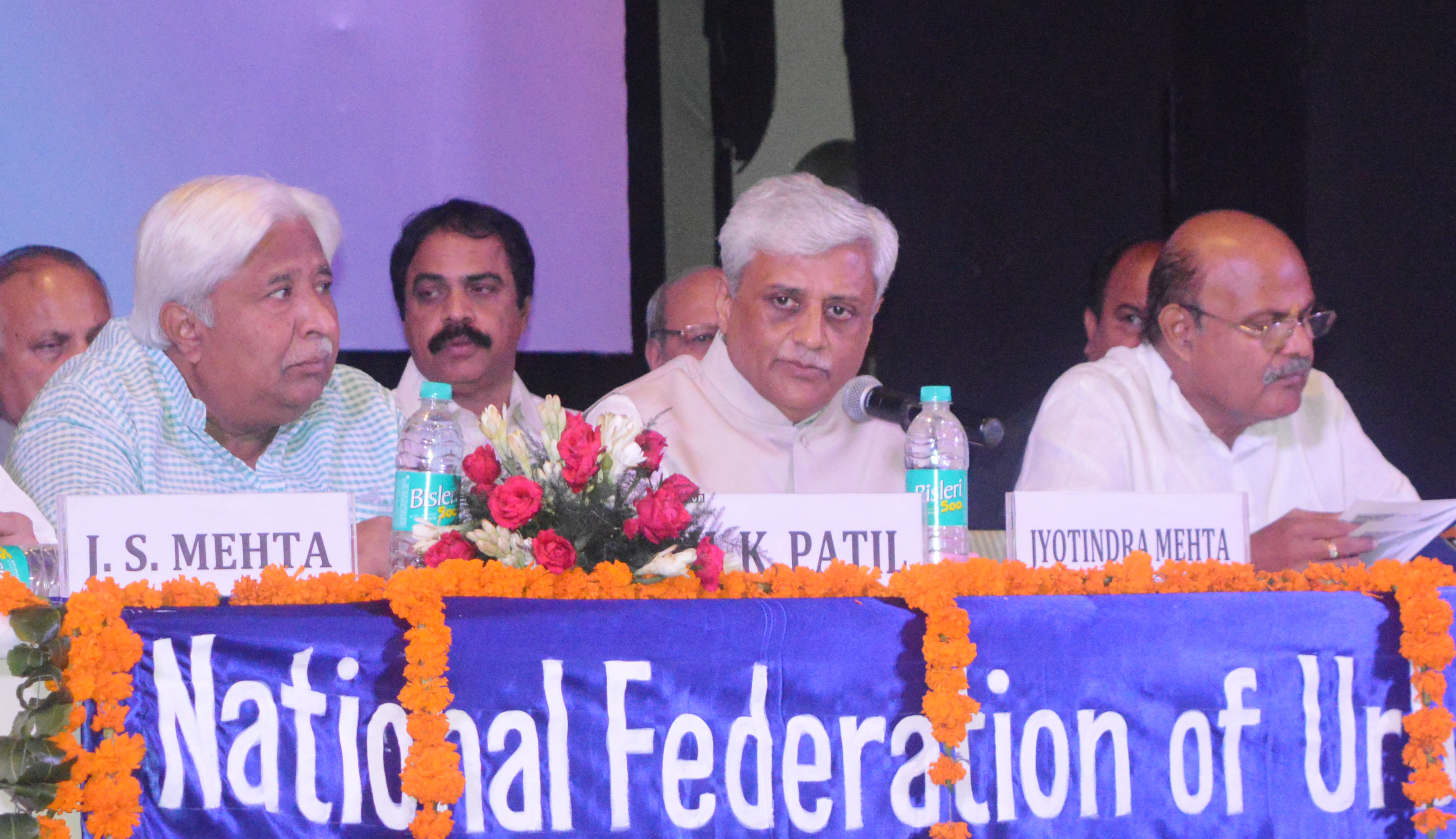
NAFCUB President Jyotindra Mehta has demanded that with the promulgation of Ordinance giving absolute right to RBI to supervise urban co-op banks, many of the restrictions imposed on UCBs from time to time in the past must be withdrawn without delay.
In a letter written to the RBI Governor, Nafcub Chief reminds him that there is a complete level playing field in the regulation and supervision of UCBs on par with commercial banks by the RBI. But is it the same when it comes to allowing UCBs to operate as the RBI allows commercial banks, Mehta asks pointedly.
Mehta lists a number of restrictions which have become redundant after the Ordinance. These are – Scheme of conversion of UCBs into SFBs; Appointment of Board of Management in addition to Board of Directors by the UCBs; Restricting lending ability of UCBs by limiting exposure ceiling to Tier I capital; Prescribing 50% loans up to Rs25.00 lakhs; and Revising targets for priority sector lending from 40% to 75% of ANBC and revision of SAF etc.
Another important point raised by Nafcub President relates to the heterogeneous character of co-op entities in the country. There are unit banks, UCBs with two or more branches operating in more than one district, uni-state banks as also multi-state UCBs operating in different states. The heterogeneity exists in geographical and financial parameters. The policy of one size fits all regulation and supervision may not be appropriate for implementation in such a situation.
Mehta demands a calibrated approach for revising the existing regulatory and supervisory framework. A revision of Vision Document 2005 is the need of the hour for which it is suggested to constitute a Committee of experts in the field with appropriate representation to all the stakeholders, he underlines.
In his letter Mehta recalls that the High-Powered Committee of R. Gandhi had recommended voluntary conversion of UCBs into Joint Stock Companies. Further, it had also recommended restrictions on branch expansion, area of operation of UCBs after a business size of Rs 20,000 crore has been achieved by the UCBs. The committee, however, was of the view that the conversion of UCBs into commercial banks/SFBs requires amendments in the provisions of all the State Cooperative Acts. Further, Sec. 17 & Sec. 121(1) of the Multi-State Cooperative Societies Act, 2002 also needed amendments.
Although the requisite amendments in the Cooperative Societies Act of all the states and in the Multi-State Cooperative Societies Act, 2002, as recommended by the Committee were not brought out by the Government of India, RBI in their haste to privatize the cooperative banks, introduced the scheme of voluntary transition of UCBs into SFBs vide their Circulars dated September 27, 2018 and December 05, 2019 ibid, the letter reads.
“UCBs have been conceived as instruments of mobilization of saving from small depositors and dispensation of credit to borrowers of small means. They play a vital role in financial inclusion in the country and have been actively participating in the economic growth of the country”, stated Nafcub President.