
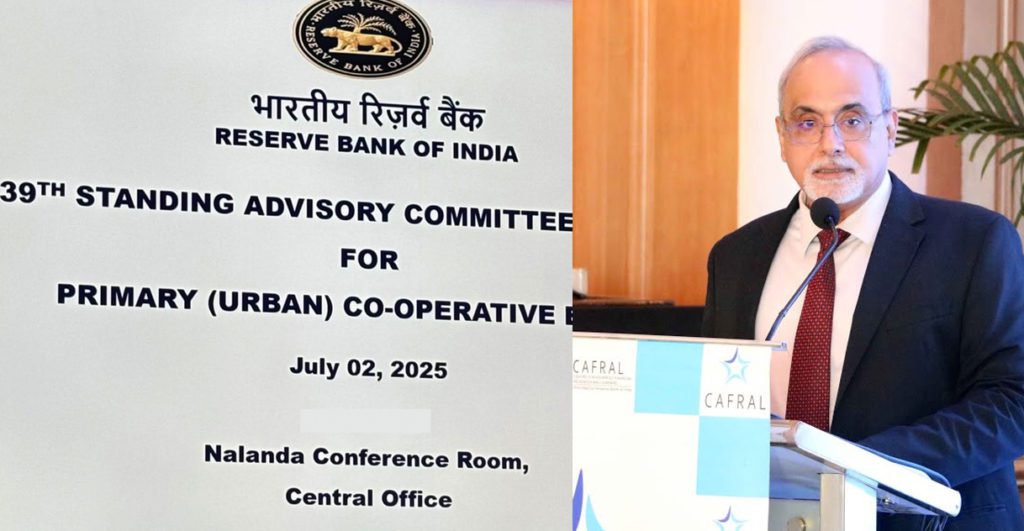
In a crucial move to strengthen the Urban Cooperative Banking sector, the Reserve Bank of India convened the 39th meeting of the Standing Advisory Committee for Primary (Urban) Cooperative Banks (UCBs) at its headquarters in Mumbai on Wednesday.
The meeting was chaired by RBI Deputy Governor M. Rajeshwar Rao and brought together cooperative leaders and other stakeholders to deliberate on pressing issues impacting UCBs.
During the meeting, several burning issues were raised by stakeholders. These included the demand to delink branch licensing from penalties, resolve conflicts between the Banking Regulation (BR) Act and State Cooperative Acts, and establish an appellate authority to review penalties imposed by the RBI.
Other key demands included allowing One-Time Settlement (OTS) without the approval of the Registrar of Cooperative Societies (RCS), permitting UCBs to open NRO accounts, and enabling banks under the Supervisory Action Framework (SAF) to reinvest recovered funds to aid their revival.
The meeting was attended by the CRCS Rabindra Agarwal, NUCFDC President Jyotindra Mehta, NAFCUB Vice-Chairman Milind Kale, Telangana UCBs Federation Working President G. Madana Gopala Swamy, Rajasthan UCBs Federation Chairman Mohan Parashar, Maharashtra UCBs Federation Chairman Ajay Bramechah, SVC Bank and Kalyan Janata Sahakari Bank Vice-Chairman, Rajasthan Principal Cooperative Secretary Manju Rajpal, among others.
Speaking to Indian Cooperative, NUCFDC President Jyotindra Mehta termed the meeting a “meaningful platform to raise sectoral concerns.” He welcomed the RBI’s positive approach on several issues. “UCBs are crucial for deepening financial inclusion and should be supported by enabling regulations,” he said.
He urged the RBI to act on pending reforms such as easing inter-bank exposure norms, granting UCBs access to government business, reducing DICGC premium rates, and permitting ASBA and NRO account facilities. “We are hopeful that constructive and timely reforms will soon be implemented to empower UCBs and enhance their competitiveness,” he added.
Key concerns raised by representatives of the cooperative banking sector during the RBI’s advisory committee meeting included the abrupt reduction of Real Estate Loan (REL) exposure to 5%. Stakeholders sought a 10% cap with a three-year glide path, highlighting that RBI’s housing loan norms, guided by Delhi High Court directions, are adversely impacting UCBs, while private players allegedly bypass them.
Another major issue was the lack of clarity around penalties, which affect a bank’s FSWM status and restrict branch expansion. Leaders demanded delinking penalties from branch licensing and called for greater transparency.
On entry point norms, NAFCUB urged the RBI to license eligible credit societies as UCBs and to harmonize the conflicts between the Banking Regulation Act and State Cooperative Acts.
Other demands included allowing Scheduled UCBs to handle government business, creating an independent appellate authority for penalty disputes, and easing inter-bank exposure limits by excluding CRR-eligible balances. Exemption from State Registrar NOCs for inter-state expansion and inclusion of IT and cybersecurity professionals on bank boards were also suggested.
Clarity on PCA norms, reduction in DICGC premium rates, and uniform guidelines for share capital were sought to ensure consistency across states.
It was also proposed that UCBs categorized as FSWM should be permitted to offer ASBA services and open NRO accounts. Additionally, banks under the SAF framework should be allowed to relend recovered amounts to support their revival.