






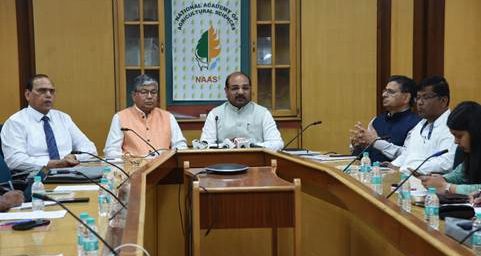
In a significant push towards reducing import dependence in agriculture, the National Academy of Agricultural Sciences (NAAS) convened a high-level brainstorming session to chart a roadmap for achieving self-reliance in fertilizers, a sector critical to India’s food security and economic stability.
The deliberations brought together representatives from government departments, academia, the fertilizer industry, and farmer groups, all of whom underscored the urgency of attaining Atmanirbharta in fertilizer production and use.
Addressing the media after the session, M. L. Jat, Secretary of the Department of Agricultural Research and Education and Director General of the Indian Council of Agricultural Research, said that achieving a self-reliant India by 2047 would hinge significantly on transforming the agricultural sector.
He noted that while fertilizers played a central role in the success of the Green Revolution, the current challenge lies in their inefficient and imbalanced use, which has led to declining productivity and environmental concerns.
India currently consumes nearly 33 million tonnes of fertilizers annually, with a substantial portion being imported, particularly phosphorus and potassium. This dependency not only exposes the country to global supply shocks but also adds pressure on foreign exchange reserves. Fertilizer subsidies have ballooned to around Rs 1.71 lakh crore in 2024–25, reflecting both high consumption and inefficiencies in nutrient use.
Experts at the session pointed out that only a fraction of applied nutrients is actually utilized by crops, with the rest lost through leaching, runoff, and other processes. This low nutrient-use efficiency increases costs for farmers while degrading soil and water quality. The prevailing fertilizer consumption ratio remains heavily skewed towards nitrogen, largely due to the widespread availability of subsidized urea.
To address these issues, participants advocated a multi-pronged strategy encompassing short-, medium-, and long-term measures. Strengthening soil health management, promoting balanced and need-based fertilizer application, and enhancing farmer awareness were identified as immediate priorities.
At the same time, the integration of advanced technologies such as artificial intelligence, precision nutrient management, and sensor-based systems was emphasized to optimize fertilizer usage.
The roadmap also highlighted the need to tap into indigenous resources such as phosphate rocks, glauconite, mica, and polyhalite, along with better utilization of industrial by-products. Increasing the use of biological inputs and exploring the potential of the soil microbiome were seen as key to reducing reliance on chemical fertilizers. Crop diversification towards pulses and oilseeds, along with improved composting and residue recycling, were also recommended.
A major proposal that emerged from the discussions was the launch of a mission-mode programme on Integrated Nutrient Supply and Management (INSAM). The initiative aims to replace at least 25 percent of mineral fertilizers with organic alternatives over the next three years.
Participants also stressed the importance of robust extension services and large-scale technology dissemination through digital platforms such as Bharat VISTAAR to ensure widespread adoption of best practices.
Policy reforms formed a central pillar of the recommendations. Experts called for bringing urea under the nutrient-based subsidy regime, repurposing subsidies to incentivize good agricultural practices, and linking benefits to soil health cards. There was also a suggestion to explore direct cash transfers of fertilizer subsidies to farmers to encourage more judicious use.
The discussions come against the backdrop of global supply uncertainties and heavy reliance on imported inputs, including natural gas used in domestic urea production. Experts warned that recent geopolitical developments should serve as a wake-up call to realign India’s fertilizer policies and research priorities towards long-term self-reliance.
With agriculture expected to play a defining role in India’s economic trajectory, the NAAS-led initiative signals a strategic shift towards sustainable, efficient, and self-reliant nutrient management systems.