






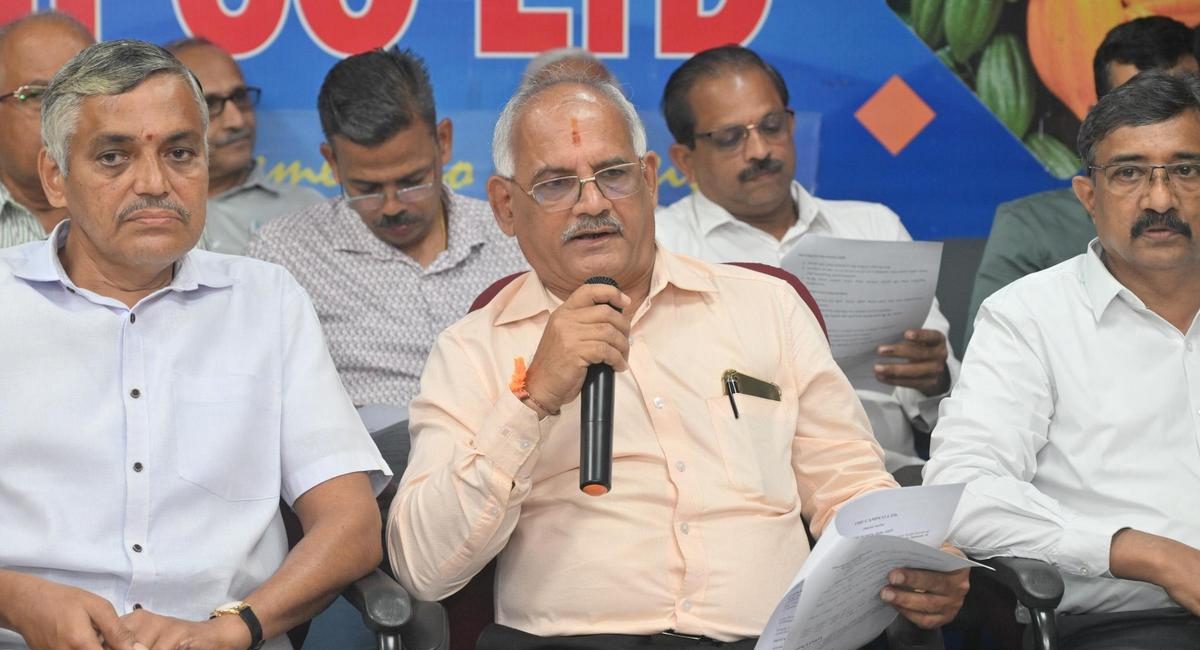
At a press conference marking the end of his tenure, CAMPCO President A. Kishore Kumar Kodgi shared his parting words, presenting a comprehensive account of the cooperative’s achievements between 2020 and 2025. He described the period as one of intense challenges, steadfast advocacy and significant transformation for farmers across Karnataka and Kerala.
Speaking with evident pride, he reaffirmed that CAMPCO’s work through these years remained firmly anchored in the founding vision laid down by Varanashi Subraya Bhat, an institution created for the farmers, by the farmers and always committed to the farmers.
The Central Arecanut & Cocoa Marketing and Processing Cooperative, which achieved full independence in 2005 after returning all government share capital, continued to strengthen this ethos over the past five years. From defending growers’ interests at every administrative level to stabilising markets and modernising infrastructure, CAMPCO navigated the period with a focus on scientific clarity, fairness and long-term farmer welfare.
A defining challenge emerged when international agencies classified arecanut as carcinogenic, causing deep concern among growers. CAMPCO launched a sustained scientific intervention to contest this categorisation. It compiled research, consulted experts and prepared evidence-based reports.
A pivotal step was a detailed presentation to Dr Soumya Swaminathan, former Chief Scientist of WHO and former Director General of ICMR. Recognising the gravity of the issue, she forwarded CAMPCO’s representation to WHO and the International Agency for Research on Cancer for re-evaluation. The agencies have since sought supporting scientific data, an important step toward initiating a review.
Providing early evidence, a study by NITTE University reported that arecanut extract was toxic to cancer cells but non-toxic to normal cells. Tests on Drosophila and zebrafish showed no adverse effects, with whole arecanut extract proving significantly safer. Researchers also suggested that a natural component in the whole nut may enhance safety. A community-level study further found that exclusive arecanut chewers were extremely few and that none showed oral cancer, adding weight to CAMPCO’s call for scientific reconsideration.
CAMPCO’s sustained advocacy resulted in a landmark decision by the Ministry of Agriculture, which approved a national, evidence-based study on arecanut and human health. Ten prestigious institutions, including AIIMS, NIMHANS, IISc, CFTRI, CCMB, NBRI and ICAR–CPCRI, were selected to undertake this multi-institutional research, marking one of the most comprehensive scientific inquiries into arecanut to date.
The cooperative also tackled several regulatory hurdles. It urged FSSAI to revise norms to recognise 11 ± 0.5% as the natural and safe moisture content for stored arecanut, instead of the current 7%. Stakeholder consultations followed, and CPCRI was engaged to conduct an aligned scientific assessment.
CAMPCO also intervened when arecanut was unexpectedly classified as forest produce, securing its removal the same day. Another critical move was addressing misuse of HSN codes for importing roasted arecanut, which led to revised import rules and an increase in the Minimum Import Price from Rs 251 to rs 351 per kg.
Through fluctuating markets and unfair private trade practices, CAMPCO ensured stable and remunerative prices for growers. Rates across all arecanut varieties rose substantially between 2020 and 2025. The cooperative also relaunched Saugandh Kaju Supari and entered the export market with shipments to the Maldives. In the pepper sector, prices nearly doubled, and new consumer products were introduced under the Kala Sona brand.
Diversification in agri inputs brought further gains, with strong sales recorded for newly introduced products such as Aayush organic manure, Poushtika micronutrient mix, Dolomite granulated lime and Maxwett wetting agent.
Members continued receiving subsidised copper sulphate and lime. Meanwhile, the chocolate factory underwent extensive modernisation, launching new product lines and adopting solar-power systems, upgraded wastewater units and advanced machinery.
Farmer welfare remained central. CAMPCO disbursed Rs 2.34 crore for healthcare and education, supported mechanisation through training programmes, set up a soil testing lab and advanced work on a mobile app to deliver real-time advisories. Over 120 jobs were created, staff capacities strengthened, and new infrastructure acquired across multiple locations. A nitrogen storage system was installed to safeguard product quality during extended storage and to serve northern markets.
Digital transformation gathered steam with the rollout of the CAMPCO SAKSHAM ERP system, a Rs 10-crore project integrating operations across the cooperative. CAMPCO also contributed Rs 5 crore to the National Defence Fund, supported COVID-19 relief efforts and donated medical equipment to public hospitals. Financially, the cooperative grew from a turnover of Rs 2,134 crore in 2020–21 to Rs 3,631 crore in 2024–25, a 70 percent rise that underscores growing market confidence.
Concluding his address, President Kodgi said that despite internal and external pressures, CAMPCO remained unwavering in its commitment to farmers. As he bid farewell, he reaffirmed that the cooperative would continue moving forward with sincerity, resilience and innovation, strengthening its mission to serve farmers today and for generations to come.