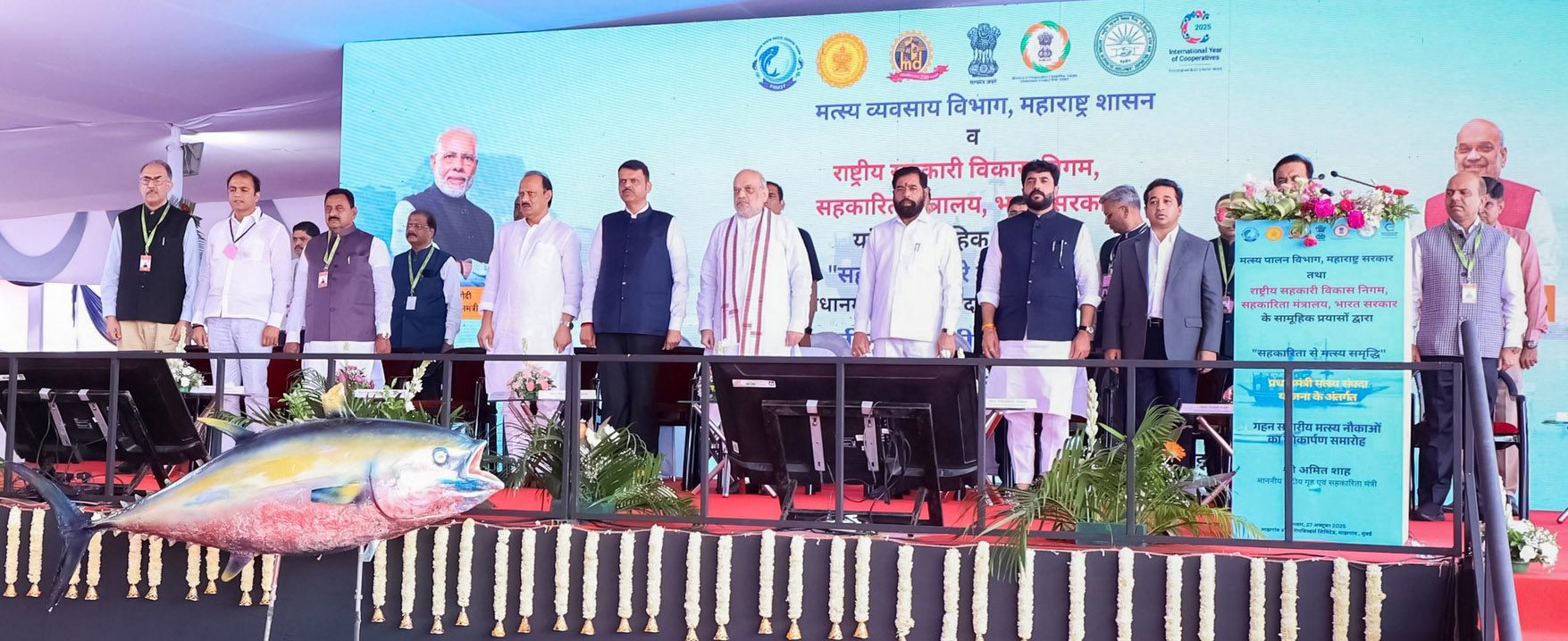







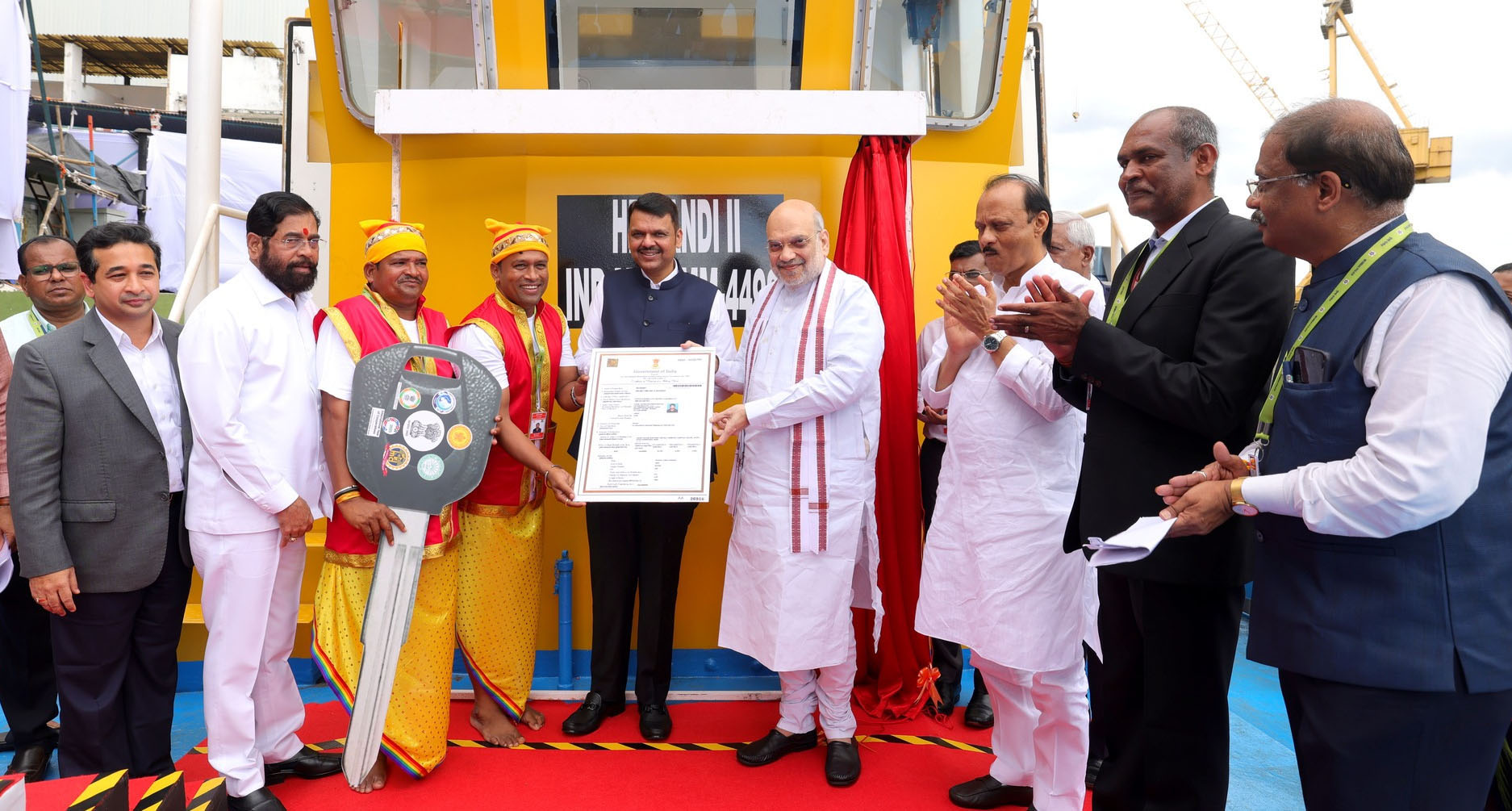
Union Home and Cooperation Minister Amit Shah inaugurated the country’s first Deep Sea Fishing Vessels under the Pradhan Mantri Matsya Sampada Yojana at Mazgaon Dock, Mumbai, marking a major step toward building a cooperative-led blue economy.
Maharashtra Chief Minister Devendra Fadnavis, Deputy Chief Ministers Eknath Shinde and Ajit Pawar, and Union Minister of State for Cooperation Murlidhar Mohol were present on the occasion.
Shah said the initiative reflects the Modi government’s commitment to the vision of Atmanirbhar Bharat, where fishermen become owners, not employees. “The hardworking poor should be the owners of the profit-this is the successful model of cooperation,” he declared, stressing that economic empowerment of the poor alone can ensure genuine national prosperity.
He explained that currently, most fishing crews work on a wage basis. The new cooperative model will transform them into stakeholders, enabling each fisherman to directly share in profits. Fourteen trawlers will be provided in the first phase, with many more planned through partnerships among the Ministry of Cooperation, the Department of Fisheries, and state governments.
Each trawler, Shah noted, is designed for extended 25-day operations in deep seas, with a carrying capacity of 20 tonnes of fish and facilities for living and dining. The vessels will be supported by larger mother ships for transportation and coordination, forming a complete cooperative ecosystem from catch to shore.
“The cooperative movement in fisheries will become a vehicle of prosperity for poor fishermen,” Shah said, adding that the government will create fish processing and chilling centers, as well as export and collection vessels, all run through cooperatives. These will help fishermen access markets directly and secure a larger share of profits.
The Minister drew parallels between the proposed fisheries cooperatives and successful cooperative models in dairy, sugar, and agriculture. He cited Amul’s women-led dairy network in Gujarat and Maharashtra’s cooperative sugar mills as proof that the cooperative approach can transform rural economies. “Amul’s 80,000-crore business reaches directly into the homes of uneducated women, empowering them and now even attracting educated entrepreneurs,” he said.
Underlining the human dimension of development, Shah argued that true progress cannot be measured by GDP alone. “A nation is prosperous only when every family can educate its children, provide balanced food, ensure healthcare, and live with self-reliance,” he said. Cooperatives, he emphasized, are the strongest mechanism to achieve this human-centric growth.
Citing data, Shah noted that India’s fisheries production has nearly doubled under Modi’s leadership-from 102 lakh tonnes in 2014-15 to 195 lakh tonnes now. Freshwater fisheries rose 119 percent, while marine production increased from 35 to 48 lakh tonnes. With an 11,000-kilometer coastline, Shah said, India has vast untapped potential that the cooperative framework will help realize.
He concluded that the Modi government aims to replicate the success of dairy and sugar cooperatives in the maritime sector, ensuring that “the profits of the blue economy flow directly to fishermen households through cooperatives.”