






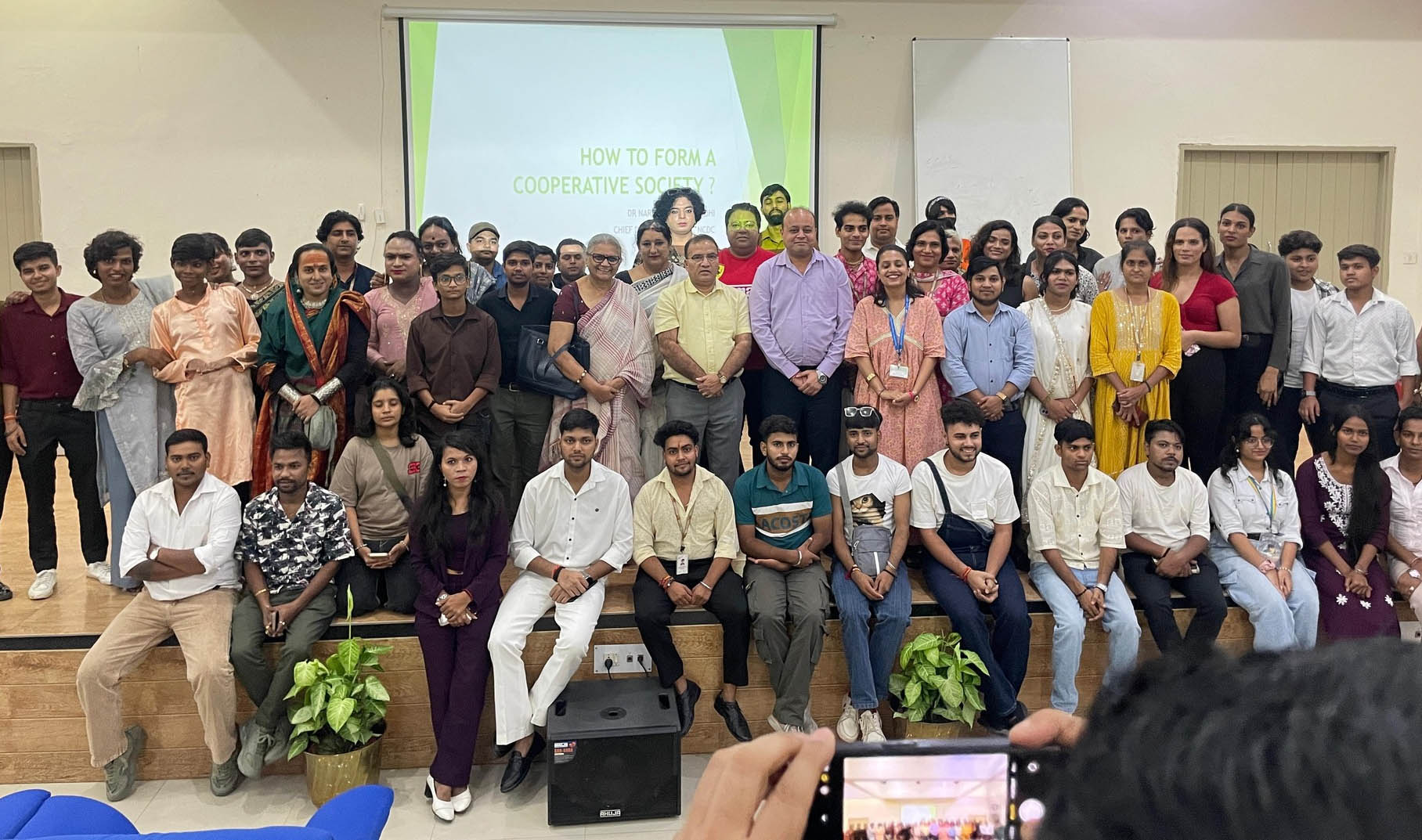
In a move that underscores the inclusive potential of India’s cooperative movement, the Department of Social Justice and Empowerment (DoSJE) in collaboration with the Laxmanrao Inamdar National Academy of Cooperative Research and Development (LINAC), the training arm of the National Cooperative Development Corporation (NCDC), and the National Institute of Social Defence (NISD), organized a special awareness programme on cooperatives for the transgender community.
The initiative drew participation from over 100 transgender persons and opened up discussions on how cooperative societies can play a transformative role in securing livelihoods, social dignity, and long-term empowerment for marginalized groups.
The programme placed cooperatives at the centre of the empowerment strategy. Experts explained that unlike individual entrepreneurship models, cooperatives function on the principles of shared resources, democratic participation, and collective responsibility. For communities that have long faced social stigma and exclusion, this model provides a platform where economic activity merges with solidarity, allowing members to work together for mutual benefit while also gaining access to institutional finance and government support.
During the technical sessions, participants were briefed on the nuts and bolts of cooperative formation, ranging from registration processes and legal compliance to financial assistance and marketing strategies. They were also made aware of the wide avenues open to cooperatives, including agricultural credit societies, skill development hubs, micro-enterprises, and social welfare initiatives. For many participants, this was the first structured exposure to the cooperative model as a vehicle for self-reliance.
Addressing the gathering, Ms. Latha Ganpathy, IAS, Joint Secretary, DoSJE, emphasized the government’s commitment to building an inclusive economy where no section of society is left behind. “Through cooperatives, the transgender community can become meaningful contributors to nation-building. The model not only ensures economic stability but also strengthens social bonds by fostering acceptance and dignity,” she said.
The Director General of LINAC further reinforced the message, noting that cooperatives have historically been instruments of transformation in rural India, uplifting farmers, artisans, women, and weaker sections. “For the transgender community, cooperatives are not just economic structures; they are platforms of empowerment where dignity, voice, and opportunity converge. They can bridge the gap between marginalization and mainstream participation,” he stated.
The programme ended with an interactive session where transgender participants openly expressed their aspirations. Many showed interest in forming cooperative societies to take up small-scale enterprises such as tailoring units, food processing ventures, and service-based initiatives, while others were keen on entering the fields of agricultural support and community development. The strong interest reflected a readiness among the transgender community to embrace collective models that promise stability, scalability, and social respect.
Officials from DoSJE, LINAC, and NISD assured participants of continued handholding support. They emphasized that training programmes, financial literacy sessions, and customized schemes would be made available to help transgender-led cooperatives not only take shape but also thrive in competitive sectors.
By situating transgender empowerment within the cooperative framework, the initiative highlighted the adaptability and inclusiveness of India’s cooperative movement. It reaffirmed that cooperatives are more than economic institutions, they are vehicles of social justice, capable of weaving marginalized voices into the broader fabric of national development.