







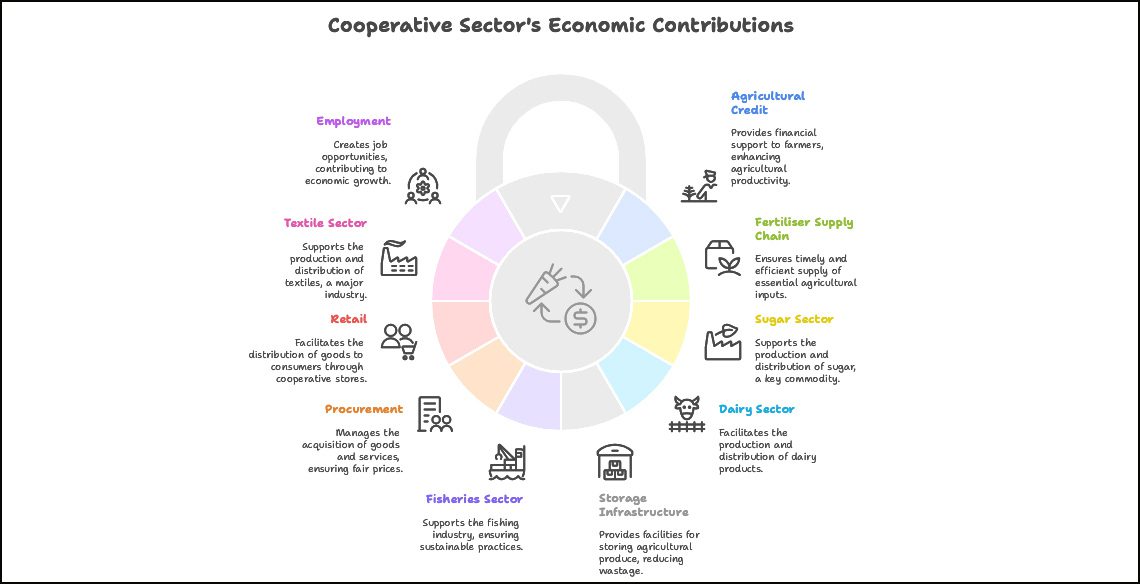
Despite the absence of a dedicated mechanism to assess the overall contribution of the cooperative sector to India’s GDP, data from the National Cooperative Union of India (NCUI) and official government sources reveal that cooperatives continue to play a vital role across several sectors of the national economy.
In a written reply to a question in the Lok Sabha, Union Minister of Cooperation Amit Shah stated that no separate database is currently maintained to quantify the exact contribution of cooperatives in the national or state-level Gross Domestic Product (GDP). However, figures from the Statistical Profile-2018 on the Indian Cooperative Movement, published by NCUI, provide valuable insight into the sector’s wide-ranging impact.
According to the report, cooperatives accounted for 13.4% of total agricultural credit disbursed in 2016-17, with 19.13% of short-term agricultural credit reaching small and marginal farmers through cooperative institutions. Furthermore, cooperatives were instrumental in issuing 50.2% of all Kisan Credit Cards (KCCs), and when including Regional Rural Banks, the share rose to an impressive 67.3%.
The cooperative sector also has a strong presence in the fertiliser supply chain. It distributed 35% of fertilisers during 2016-17, accounted for 28.8% of total fertiliser production, and had a 25.6% share in installed fertiliser manufacturing capacity (N Nutrient). In the case of P Nutrient fertiliser units, the installed capacity under cooperatives stood at 23.53%.
In the sugar sector, cooperatives owned 38.63% of sugar factories and contributed 30.6% of total sugar production in 2016-17. They also achieved a capacity utilisation rate of 46.14%, reflecting their efficient operations.
Dairy cooperatives emerged as one of the most prominent contributors, marketing 84.17% of the total liquid milk procured by them. While they procured 9.5% of total milk produced, their share increased to 17.5% when compared to marketable surplus.
Storage infrastructure is another area where cooperatives play a crucial role. Primary Agricultural Credit Societies (PACS) with village-level storage facilities accounted for 55.5%, and the cooperative sector had a total storage capacity of 22.77 million metric tonnes, representing 14.79% of the national capacity.
In the fisheries sector, 20.05% of active fishermen were part of cooperative networks. Cooperatives also contributed to 13.3% of wheat procurement and 20.4% of paddy procurement.
Cooperative-run retail fair price shops accounted for 20.3% of outlets, and in the textile sector, they held a 29.34% share in total spindleage as of March 2018.
The sector also plays a notable role in employment, generating 13.3% of direct employment and enabling 10.91% of self-employment opportunities in various parts of the country.
Meanwhile, Shah also mentioned the efforts to improve fund flow tracking through the Public Financial Management System (PFMS), a web-based application developed by the Controller General of Accounts. Under government guidelines, all implementing agencies of Central Sector Schemes are now required to register on PFMS and use the Expenditure Advance and Transfer (EAT) module to ensure real-time fund tracking and efficient, just-in-time fund release up to the last mile.
These figures underline the significance of the cooperative model in India’s economic fabric, particularly in rural development, agriculture, and allied sectors. As the government pushes for digitalisation and structural reforms in the sector, the cooperative movement continues to serve as a powerful vehicle for inclusive growth.