







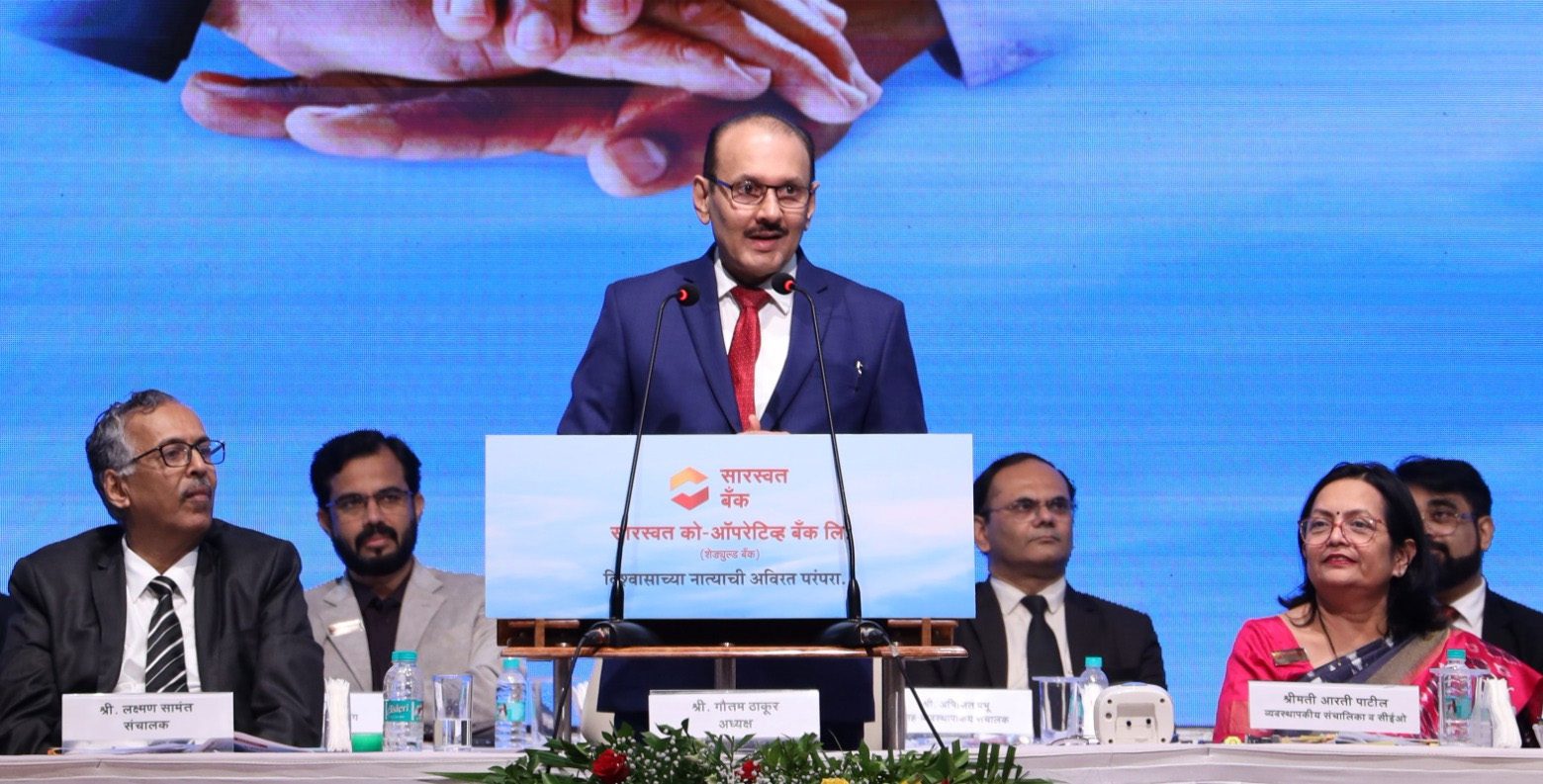
In a bold and visionary move, Saraswat Co-operative Bank, India’s largest urban co-operative bank, has spelled out its ambition to function as a Universal Bank within the co-operative sector, provided there is enabling regulation in place. This would be a first-of-its-kind development in the country.
The bank’s Chairman, Gautam E. Thakur, shared this vision in the bank’s Annual Report for FY 2024–25, highlighting that the N.S. Vishwanathan Expert Committee Report (dated 31st July 2021) had envisaged the creation of universal banks from among Tier IV co-operative banks.
He also reiterated that Saraswat Bank has no intention of converting into a private bank and remains firmly committed to the co-operative model.
Speaking at the Annual General Meeting held on Wednesday, Thakur added that “Thinking Big” has always been a part of Saraswat Bank’s DNA. What sets the institution apart, he emphasized, is its ability to convert dreams into reality while staying true to its core values, Customer Service, Integrity, and Trust. The bank continues to live up to its tagline: “Building Trust Across Generations.”
The bank posted robust financial growth during the year. Its total business rose from Rs 82,024.77 crore as on 31 March 2024 to Rs 91,814.07 crore as on 31 March 2025, marking a year-on-year growth of nearly 12%. This includes the bank’s highest-ever incremental business growth of around Rs 9,800 crore in a single year.
“We are not only aiming at the Rs 1 lakh crore business mark, which is just around the corner, but will also be propelling towards the next Rs 1 lakh crore within the next decade itself,” Thakur stated, considering the current pace of growth.
Saraswat Bank’s Net Profit stood at Rs 518.25 crore. The deposit base grew from Rs 49,457.31 crore to Rs 55,481.27 crore (12.18% growth), while advances rose from Rs 32,567.46 crore to Rs 36,332.80 crore (11.56% growth). Both wholesale and retail lending portfolios registered healthy growth.
Impressively, the bank has maintained zero Net NPAs for three consecutive years, despite having the largest asset book in the urban co-operative banking sector. The Gross NPA ratio also declined significantly from 2.88% to 2.25% during the financial year.
Demonstrating prudent financial management, the bank created an additional floating provision of Rs 125 crore against advances in the previous year, a pioneering step in India’s co-operative banking space. The bank’s Capital to Risk Weighted Assets Ratio (CRAR) also improved from 17.28% to 17.43%, further strengthening its financial position.
Commenting on its market positioning, Thakur observed that while Small Finance Banks (SFBs) have emerged as a new category in recent years, Saraswat Bank surpasses many of them in size, profitability, and asset quality. He said the bank now finds itself competing with larger public and private sector banks, not just other co-operative institutions.
A major highlight of the AGM was the shareholders’ appreciation for the amalgamation of New India Co-operative Bank Ltd (NICBL) with Saraswat Bank. Post-merger, Saraswat Bank will take over all the assets and liabilities of NICBL while fully protecting the interests of its 1.5 lakh depositors.
If regulatory conditions permit, Saraswat Bank could soon emerge as India’s first universal co-operative bank, setting a powerful precedent and opening new pathways for the co-operative banking ecosystem across the country.












































I want to do work here (saraswat bank )