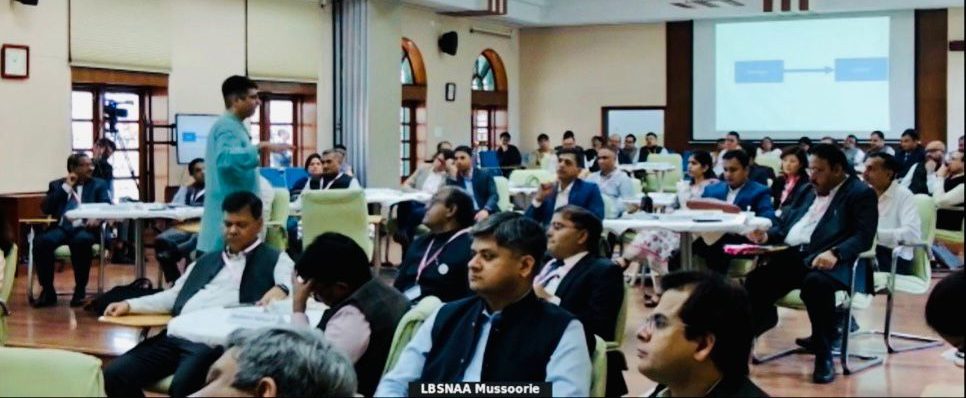







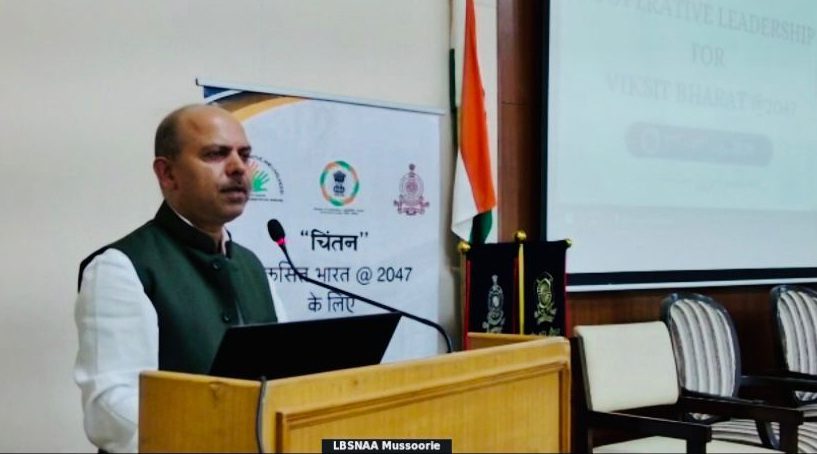
The two-day National-Level Review Meeting of the Ministry of Cooperation concluded at LBSNAA, Mussoorie with a strong resolve to intensify grassroots cooperative development. In his valedictory address, Secretary Dr. Ashish Kumar Bhutani called for mission-mode action to establish cooperative societies in every Indian village, ensuring inclusion of landless farmers and greater community participation.
Dr. Bhutani urged stakeholders to swiftly implement revised model bye-laws and formulate district-specific action plans to foster cooperative expansion. He emphasized the need for capacity-building initiatives rooted in cooperative principles and suggested launching campaigns like #EkPedMaaKeNaam2.0 as part of the build-up to the International Year of Cooperatives (IYC) – 2025.
The Secretary asserted that the sector is experiencing transformative growth under the visionary leadership of Prime Minister Narendra Modi and Union Home and Cooperation Minister Amit Shah. He outlined a vision for a self-reliant and inclusive cooperative ecosystem with deep grassroots reach.
The meeting featured several high-level thematic sessions focused on institutional strengthening, innovation, and sectoral convergence. In a key session, IIM Ahmedabad’s Prof. Rajesh Chandwani presented on strategic human resource development, urging adoption of modern HR practices and leadership models to drive cooperative excellence. The session attracted participation from senior officials across States and Union Territories.
 A major workshop on cooperative banking was chaired by Pankaj Kumar Bansal, Additional Secretary, Ministry of Cooperation and Managing Director of the National Cooperative Development Corporation (NCDC).
The session explored ways to strengthen Urban Cooperative Banks through revitalization of the Task Force on Urban Co-operative Banks (TAFCUB), enhance State Cooperative Bank participation in the Shared Services Entity, and deepen engagement with the National Urban Cooperative Finance and Development Corporation (NUCFDC).
Institutions such as NAFCUB, NABARD, and NUCFDC made detailed presentations, followed by a panel discussion with representatives from Maharashtra, Karnataka, Madhya Pradesh, Haryana, Bihar, Tamil Nadu, and Uttar Pradesh. The dialogue emphasized collaboration, improved governance, technology adoption, and financial sustainability in the cooperative banking space.
Another significant session reviewed progress across key segments of the cooperative ecosystem. It addressed the role of apex organizations like NCEL, NCOL, BBSSL, NCCF, and NAFED, and evaluated the Grain Storage Plan’s rollout through cooperative networks.
Progress on the National Cooperative Database and efforts to strengthen Primary Agricultural Credit Societies (PACS) through convergence initiatives were also assessed.
Participants reaffirmed their commitment to align with the national cooperative vision and prioritize universal outreach. The discussions underlined the need for inter-state knowledge sharing, cross-sectoral integration, and strategic planning to empower cooperatives as engines of rural and economic development.
The event concluded on an optimistic note, with a collective pledge from States and institutions to accelerate cooperative reforms, nurture leadership at the grassroots, and ensure that cooperatives become a driving force for inclusive and sustainable national growth.