







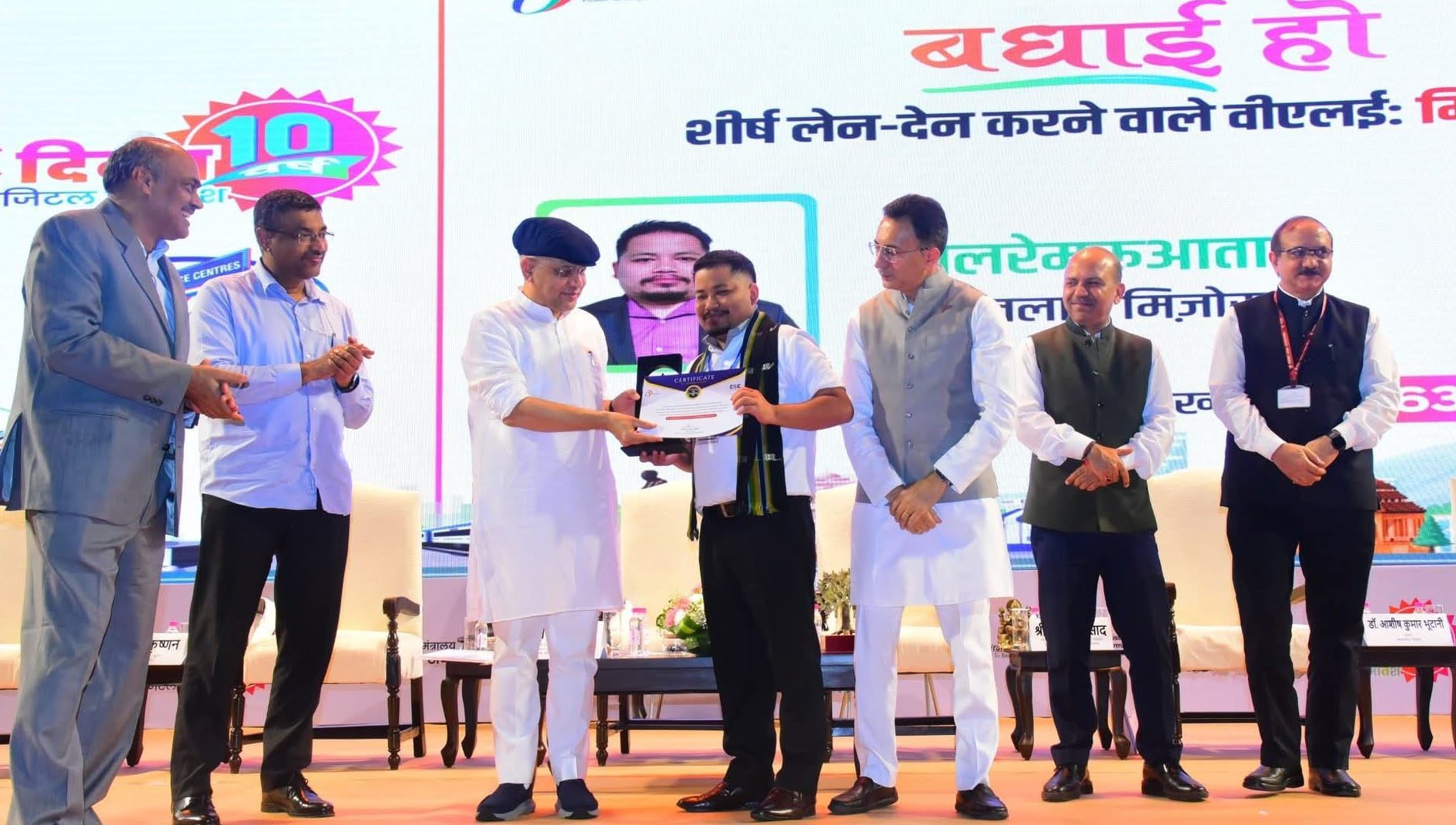
The Common Service Centre (CSC) e-Governance Services India, under the Ministry of Electronics and Information Technology (MeitY), celebrated ten transformative years of Digital India at Yashobhoomi Convention Centre in New Delhi. The milestone event highlighted CSC’s pivotal role in rural empowerment through cooperative structures, digital agriculture services, and last-mile delivery of governance.
Gracing the event were Union Minister for Electronics and Information Technology Ashwini Vaishnaw and Union Minister of State Jitin Prasada. Vaishnaw applauded the Village Level Entrepreneurs (VLEs) for their unwavering efforts in extending digital services even to remote agrarian communities. “When the world doubted whether a farmer or vendor could use digital payments, India showed the way. UPI today surpasses Visa. This is the strength of our 1.4 billion citizens,” he remarked.
The Minister emphasized CSC’s rural reach, now covering nearly 90% of Indian villages. Highlighting its significance in cooperative and agricultural sectors, he cited success stories of women VLEs like Manjulata from Odisha’s Mayurbhanj and Rose Angelina from Meghalaya, who, through their CSCs, not only delivered services but helped digitally uplift entire farming communities.
Underscoring agriculture’s digital transformation, Vaishnaw announced free Artificial Intelligence (AI) training for 10 lakh individuals, with a focus on enabling VLEs, many of whom operate within or alongside cooperatives, to offer smart agriculture solutions. He also encouraged VLEs to expand into railway ticketing and urged state governments to integrate their IT systems with CSC-SPV for seamless service delivery.
Minister of State Jitin Prasada highlighted CSCs as engines of grassroots growth. “In 2014, we had only 83,000 CSCs. Today, we have over 5.5 lakh, many of them embedded within Primary Agriculture Credit Societies (PACS). These centres are redefining last-mile connectivity and enabling farmers to access vital services directly,” he said.
 Prasada particularly noted the role of women-led cooperatives and VLEs in this journey, stating that over 74,000 women VLEs are leading transformative efforts. With technology evolving rapidly, especially in AI and data, he emphasized that CSCs are uniquely positioned to revolutionize rural livelihoods through precision farming tools, soil health advisories, and market linkages via platforms like Grameen eStore.
Calling for broader capacity building, he said CSCs must become one-stop hubs for essential services in agriculture, health, and education. He recommended authorizing VLEs to facilitate Update Client Lite and state-level welfare services to enhance their economic sustainability, especially in rural and cooperative-led areas.
Welcoming dignitaries, CSC SPV MD & CEO Sanjay Rakesh said, “There is no need to visit cities anymore. With CSCs now integral to cooperative societies and rural clusters, governance is reaching farms, fields, and families.” He affirmed CSC’s role as a beacon of inclusion and expressed confidence in its continued success under the Prime Minister’s vision of Sabka Saath, Sabka Vikas.
Nationwide celebrations marked CSC Diwas, culminating in the July 15–16 event in Delhi where state IT Secretaries gathered to deliberate on rural digital strategy. From July 1–15, CSCs across the country hosted activities engaging farmers, cooperative members, and citizens, while top-performing VLEs, many from agricultural regions, were recognized for driving rural digital change.
Launched in 2015 by Prime Minister Narendra Modi, Digital India has grown into one of the world’s largest e-governance platforms. CSC SPV, with over 5.5 lakh centres, continues to anchor this transformation, especially through its focus on agriculture, cooperatives, and inclusive service delivery in rural India.