






By Anca Voinea
It’s just over a year since the UN designated 2025 as the International Year of Cooperatives (IYC), during a session of its General Assembly. Halfway through the year, what has been achieved and what should co-ops do to build on the IYC momentum?
“We are pleased with the global momentum the movement has generated with the first half of the International Year of Cooperatives,” says Joseph Njuguna, director of policy at the International Cooperative Alliance (ICA).
Key highlights, he says, include the year’s soft launch at the UN headquarters in New York in July 2024, which set the tone for high-level engagement at the international level.
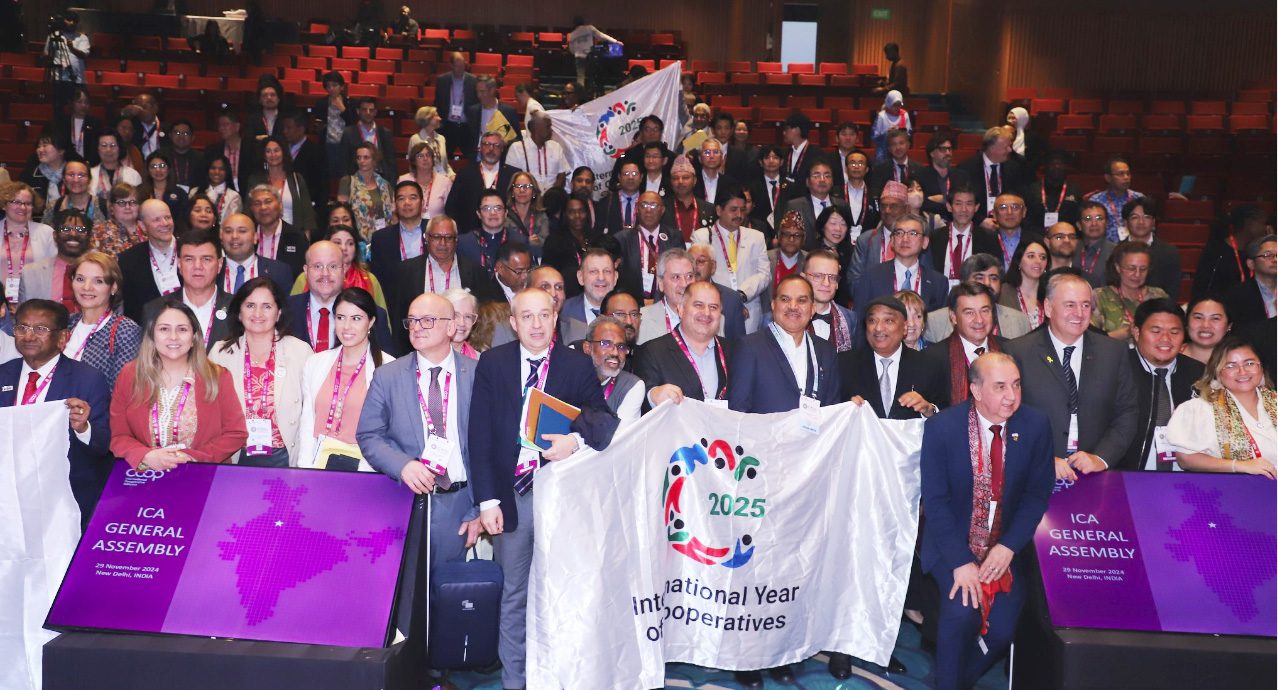
Another highlight was the official launch of the year during the ICA’s Global Conference in New Delhi, India, in November last year, an event featuring high-level politicians such as India’s prime minister Narendra Modi and the prime minister of Bhutan, Tshering Tobgay, among other ministers and co-operative leaders.
UN secretary general António Guterres also addressed the conference via a video message in which he emphasised the importance and global relevance of co-operatives. Conversations continued at the 63rd UN commission for social development which, for the first time, featured a session dedicated to co-operatives, in the context of promoting solidarity and social cohesion.
“It was quite important to see co-operatives being recognised at such an event,” Njuguna says.
In addition to these events, the ICA launched the Cooperative and Mutuals Leadership Circle (CM50), to bring together leaders of large organisations to champion the co-operative and mutual business model on the global stage, showcasing its potential to accelerate the SDGs.
“We had our first physical meeting in Madrid in May, and we could see the commitment that these co-operative mutual leaders have,” says Njuguna. “And they were looking at how to foster growth and innovation in co-operatives and how to influence global policy outcomes.”
Around the world, co-operatives have been holding events to celebrate the year, with 100 activities organised by ICA partners and members so far in 2025. More than 900 applications to use the official IYC logo from 124 countries have been received. The official ICA IYC website has been accessed by 50,000 people, and co-operatives have also used stories.coop to tell their stories, with 30 sending articles for publication on the platform.
“We have received a lot of positive feedback from our members and partners,” adds Njuguna. “This includes UN agencies we work with, such as the Committee for the Promotion and Advancement of Cooperatives (Copac), the International Labour Organization, the Food and Agricultural Organization, the UN Department of Economic and Social Affairs (Undesa) and the International Trade Center (ITC) – these are UN agencies that are supporting advancing the co-operative agenda at the global level.”
Co-ops in the Americas has also set up a regional committee to coordinate events related to the IYC. With all these events taking place, does the ICA feel that its key IYC objectives are on track to being achieved?
“When IYC was launched, we had four key objectives,” says Njuguna, “to raise awareness about co-operatives and their impact, to strengthen the enabling legal and policy frameworks, to foster pro-sectoral, multi-stakeholder partnership, ensuring that co-operatives are able also to partner with the other organisations, co-operatives themselves, and to build capacity and leadership within the movement, especially for young people and also for women.”
Based on the activities and initiatives that have taken place so far this year, Njuguna thinks the progress towards meeting these objectives is heading in the right direction.
Notable achievements, he says, include the widespread use of the IYC logo, and the adoption of political declarations to support co-ops, such as the resolution recently passed by the Japanese Parliament, which calls for the promotion of co-operatives.
All these initiatives are building up momentum for co-operatives ahead of the Second World Summit for Social Development (WSSD2) in Doha, Qatar, in November, which will be an opportunity for co-ops to engage on social development issues at the highest level.
Promoting social justice, inclusion and innovation is something co-ops do every day, says Njuguna, which is why they should participate in the event. In addition, heads of state will be coming together at the summit to adopt a political declaration that will shape the UN’s Sustainable Development agenda post-2030. The initial zero draft of this declaration mentions co-operatives.
“The political declaration that will be adopted in Doha will shape whatever next agenda the UN will be adopting. So it is good to ensure that co-operatives are at the table when these discussions are happening,” he says.
Ahead of the summit, the ICA’s CM50 leaders are drafting their own manifesto and commitment plan, which they hope will influence discussions at the UN level.
“Our main objective for Doha is to secure a strong action-oriented language for the political declaration that positions co-operatives and mutuals as key actors in advancing social development, inclusion and decent work,” adds Njuguna.
“Since that summit will bring together governments and different stakeholders, it’s a good environment to discuss how we can partner with governments, and seek support from them.”
The ICA will also be working to mobilise governments and stakeholders to adopt measurable commitments, like the UK government has done with its pledged to double the size of the co-operative and mutual economy.
The official UN IYC closing event will take place at the WSSD2 but celebrations will continue until the end of 2025. Yet Njuguna points out that the IYC is a launch pad, not a finishing line. His message to co-operatives and co-operators is to use this moment to elevate their voice form new partnerships and drive local action.
“The legacy of IYC will depend on how outcomes will be embedded into long-term national strategies, policy reforms and co-operative growth plans,” he says, “so co-ops should continue sharing their success stories and their impact at the local level and regional level, and engage policymakers at all levels.”
Njuguna adds that investing in young people and promoting digital inclusion should also be on the co-ops’ agenda, in addition to ensuring they align with the Sustainable Development Goals (SDGs).
“So let’s carry this energy forward from the momentum that we have gained during the IYC, and ensure co-operatives remain central to shaping a fair, sustainable, inclusive future and continue building a better world.”
Courtesy: Coopnews