






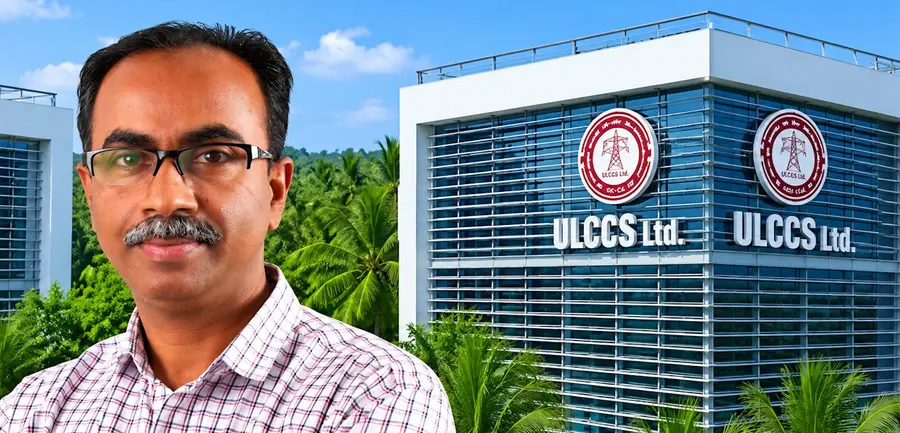
The change of leadership at Kerala-based Uralungal Labour Contract Co-operative Society (ULCCS) following the demise of its long-serving Chairman Remeshan Palery is unlikely to interrupt the cooperative’s growth trajectory, with experienced leadership already in place and a substantial project pipeline supporting its expansion plans.
The ULCCS Board has elected S Shaju as Chairman, while Chief General Manager K Praveen Kumar has been entrusted with the responsibility of Managing Director. Shaju succeeds Palery, whose leadership over several decades helped transform ULCCS from a traditional labour cooperative into a diversified, technology-driven institution with a growing presence beyond Kerala.
Shaju brings nearly three decades of experience with ULCCS, including his tenure as Managing Director. His elevation therefore represents more a continuity of the organisation’s strategic direction than a break from the past. He has been closely involved in the cooperative’s diversification into technology, infrastructure and other emerging areas.
The fundamentals supporting ULCCS’ growth remain strong. The Kerala State Planning Board has reported that the society directly supports the livelihoods of more than 13,000 workers and had a project portfolio of nearly Rs 4,994 crore after adding 1,380 projects worth Rs 2,539 crore. ULCCS has also consistently figured among the world’s leading cooperatives in the International Cooperative Alliance’s World Cooperative Monitor.
Financial indicators too point to a sizeable order pipeline. According to an Acuité assessment, ULCCS had an unexecuted order book of about Rs 5,235 crore as of 2025, while revenue during the first nine months of FY2026 stood at around Rs 1,658 crore. The rating agency expects revenue to improve steadily on the strength of the order book.
More importantly, ULCCS has already built a diversified growth model. Alongside its core construction business, it has developed capabilities in IT, real estate, tourism, hospitality, skilling and technology-enabled infrastructure. UL CyberPark has emerged as a major IT destination in northern Kerala, while UL Technology Solutions and U-Sphere have widened the cooperative’s technology and engineering footprint.
The cooperative has also been actively looking beyond Kerala. U-Sphere is targeting infrastructure, commercial and industrial projects in Karnataka and Tamil Nadu, while ULCCS has been exploring opportunities in new markets.
In March 2026, the society announced UL Actant and UL N’Shore, focusing on electrical engineering, renewable energy and premium interiors, with the two ventures projected to generate Rs 4,000 crore in revenue and about 3,500 jobs over the next decade.
The immediate task for Shaju and Praveen Kumar will therefore be to maintain execution momentum while carrying forward Palery’s emphasis on quality, innovation, employment generation and cooperative values.
With a strong institutional structure, experienced second-line leadership, a sizeable order book and multiple new businesses already underway, the change of guard appears positioned as a phase of continuity and consolidation rather than a disruption to ULCCS’ growth story.