






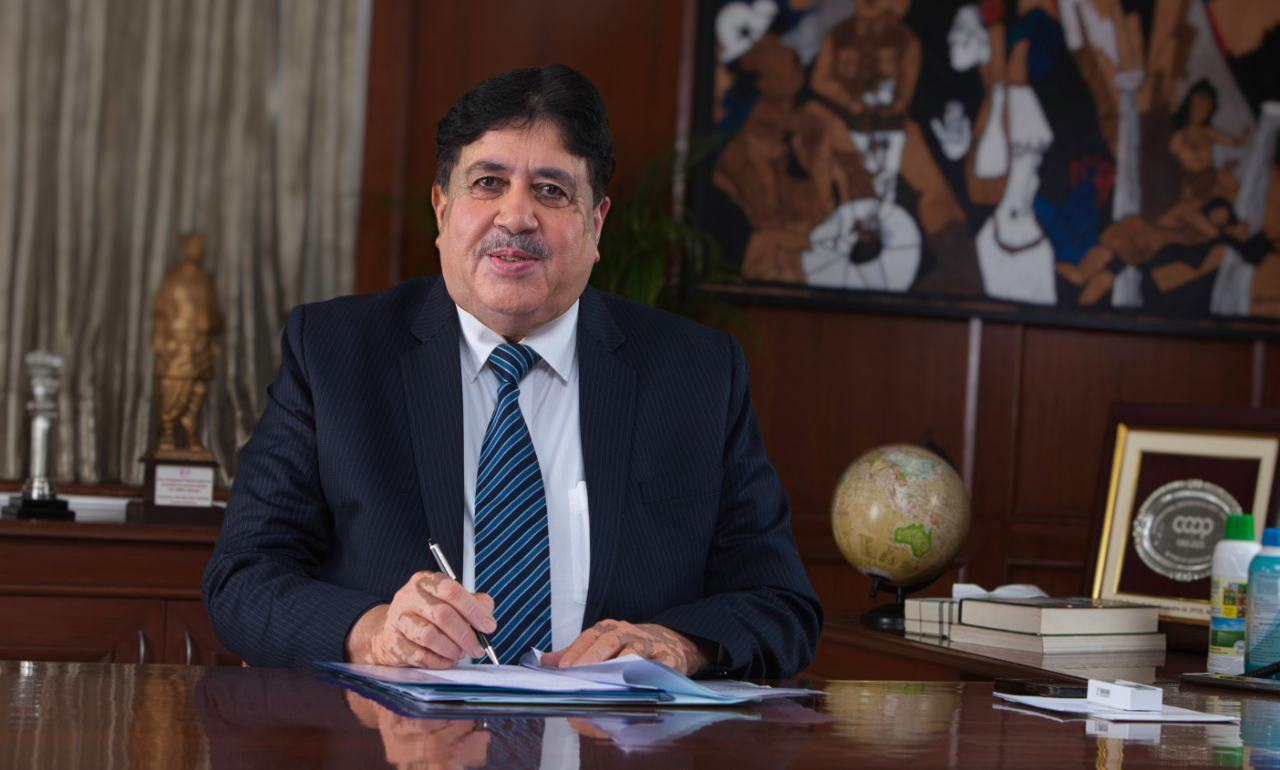
When a cooperative leader seeks a place on the board of the International Cooperative Alliance (ICA), the question is not merely what position he holds today, but what he has built, changed and delivered over the course of his career. By that measure, Dileep Sanghani enters the ICA Global Board race with an unusually rich record spanning grassroots cooperation, cooperative banking, dairy, politics, public policy and global cooperative engagement.
Sanghani’s cooperative journey goes back more than four decades. One of his most consequential contributions came in 1994, when, as chairman of Amreli District Central Cooperative Bank, he Pioneered the Kisan Credit Card model for farmers. The initiative was later adopted nationally as the KCC framework, making his Amreli experiment an important chapter in India’s agricultural-credit story.
His approach was characteristically farmer-centric. He has also spoken of the idea of enabling farmers to obtain housing loans through cooperative banks, questioning why a salaried employee could qualify for a housing loan while a farmer owning land for decades could not. The larger philosophy was simple: cooperative finance should respond to the real-life needs of its members. Thus, the Scheme Apna Ghar was launched, benefiting hundreds of farmers.
Then came Amar Dairy. Sanghani is credited with building the Amreli cooperative dairy into a successful venture. Contemporary reports describe him as its founder, while Prime Minister Narendra Modi has publicly praised Amar Dairy’s contribution to employment in the region.
His intervention in NAFED’s difficult phase is another illustration of his ability to combine cooperative leadership with political access. As NAFED vice-chairman, Sanghani repeatedly took up the federation’s revival with the government, including discussions with Prime Minister Modi. At the time, NAFED was facing severe financial stress and a revival package was being considered. Subsequent government procurement helped the organisation return to business and profitability. Thus, NAFED Revival was made possible by his intervention.
At IFFCO, Sanghani now operates on a much larger canvas. Under his chairmanship, the fertiliser cooperative IFFCO reported its highest-ever PBTfor FY2025-26, projected at over Rs 4,106 crore.
His international credentials are equally relevant. Sanghani led India’s role in hosting the historic ICA Global Cooperative Conference and General Assembly in New Delhi in 2024. He served as president of the conference, welcomed global cooperative leaders and played a visible role in the launch of the International Year of Cooperatives 2025. ICA itself describes him as a cooperative leader of more than 40 years and notes his leadership in hosting the 2024 global assembly.
Four terms in Parliament and experience as a Gujarat cabinet minister add another dimension: Sanghani understands how cooperative aspirations can be translated into public policy.
For ICA, therefore, the case for Sanghani is not simply about India. It is about choosing a leader who has worked at the village, bank, dairy, federation, government and global-cooperation levels and understands how all these pieces must come together to make cooperation deliver.
That, ultimately, is Sanghani’s cooperative DNA.