





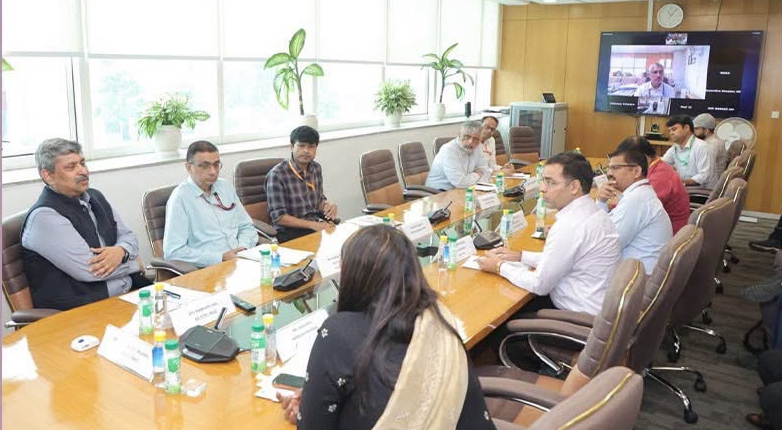
Dr. Ashish Bhutani, Secretary, Ministry of Cooperation, chaired an inter-ministerial meeting on Tuesday in New Delhi to advance the government’s One Stop Shop (OSS) initiative through Primary Agricultural Credit Societies (PACS), signalling a major push to transform village-level cooperatives into comprehensive business and service centres.
Held at Atal Akshay Urja Bhawan, the meeting brought together constituent departments of SGoS-1, with discussions centred on leveraging PACS’ extensive rural network and growing digital infrastructure to take government services, welfare schemes, products, training and market linkages closer to citizens and farmers.
The participating departments were asked to identify suitable programmes and services that can be delivered through PACS. These initiatives will subsequently be mapped with appropriate PACS and geographical locations for pilot implementation before being scaled up across the country.
The initiative is designed to give PACS a much larger role in the rural economy. Instead of functioning primarily as credit institutions, PACS can emerge as integrated village-level platforms where farmers and rural citizens access multiple government and market-linked services under one roof.
This could reduce the need for villagers to approach multiple agencies while simultaneously creating new business opportunities and revenue streams for cooperatives.
The proposed convergence spans a wide range of sectors, including food distribution, food processing, agriculture and farmers’ welfare, fertilisers, Panchayati Raj, consumer affairs, agricultural research and education, rural development, fisheries, animal husbandry and land resources.
The meeting was attended by Siddharth Jain, Additional Secretary, Ministry of Cooperation, along with senior officials and representatives from the concerned departments.
The One Stop Shop initiative assumes significance amid the government’s broader effort to modernise and diversify PACS through computerisation, digital services and new economic activities. By bringing multiple schemes and services onto a common cooperative platform, PACS could become a critical last-mile delivery mechanism for rural India.
The move also strengthens the Ministry of Cooperation’s larger vision of “Sahkar Se Samriddhi”, under which cooperatives are being positioned as engines of inclusive rural growth.
If the pilots succeed, the PACS network could evolve into one of the country’s most extensive grassroots service-delivery ecosystems, combining credit, government services, technology, training and market access at the village level.